
Lee Hee-moon to return with 'Folk Songs Across Korea'
Singer Lee Hee-moon is returning to the stage with 'Folk Songs Across Korea,' the final installment of his 'Deep Sarang' series, which explores the lives of female folk singers during the era of modernization.
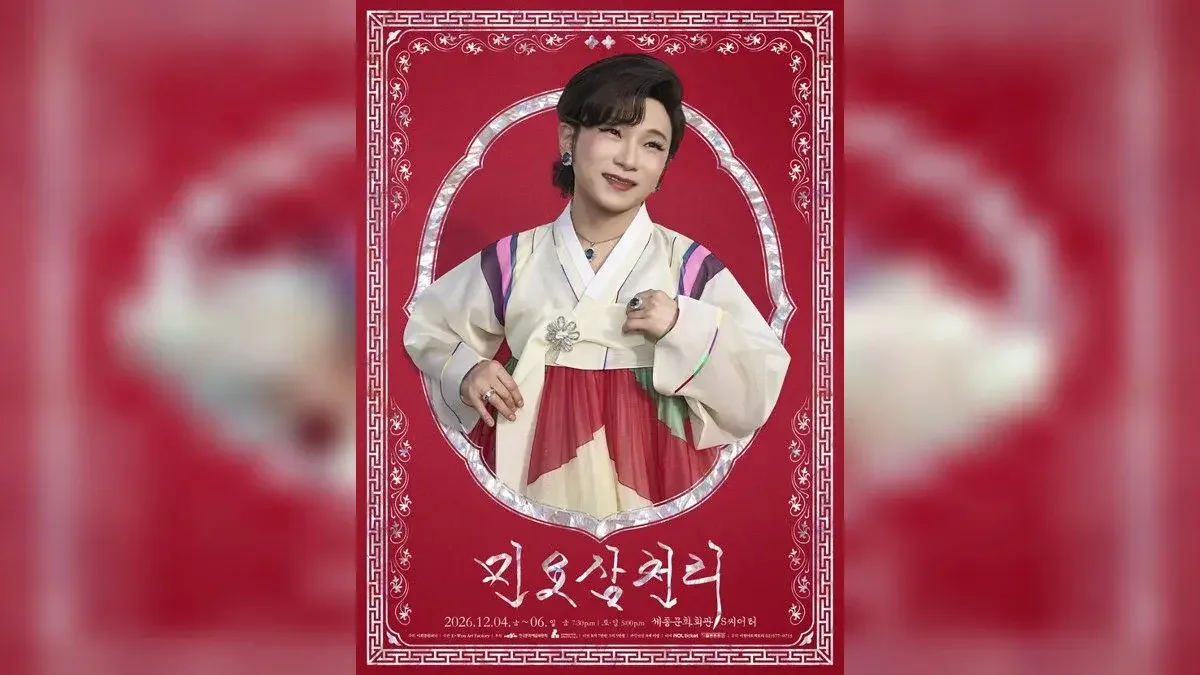
Singer Lee Hee-moon will return to the stage in 'Folk Songs Across Korea,' the final installment of the 'Deep Sarang' series, marking his first such production in six years. The performance follows the lives of female master singers and uses a 1968 album as a guide to explore how folk songs evolved into modern traditions.
Singer Lee Hee-moon's 'Folk Songs Across Korea' will return to the stage for the first time in six years since 2020.
'Folk Songs Across Korea' poster
The production recreates a time when folk songs were much closer to people's daily lives. In those days, singers were called to banquets to heighten the excitement, and people enjoyed music in traditional reception rooms. Folk songs flowed through radios and televisions, and master singers dressed in hanbok were popular stars of the era. 'Folk Songs Across Korea' brings this scenery back to the stage, depicting a time when folk songs were at the very center of everyday life.
'Folk Songs Across Korea' is the third work in the 'Deep Sarang' series, which Lee Hee-moon presented over three years starting in 2016. As the final story following Part 1, 'Deep Love,' and Part 2, 'Four Seasons,' it retraces the history of Gyeonggi folk songs through the lives and songs of female singers who were prominent in their time.
The 'Deep Sarang' series began as an exploration of traditional sounds, particularly Gyeonggi folk songs. It focused on the reception room culture where sounds were enjoyed in the past, presenting the formation and evolution of the sounds we call "tradition" today on stage. While Part 2, 'Four Seasons,' focused on the lives and sounds of male singers, Part 3, 'Folk Songs Across Korea,' shifts the focus to the stories of female singers who stand as their counterparts.
The starting point of the work is the 1968 album of the same name, 'Folk Songs Across Korea.' This album, which captured folk songs from various regions through the voices of female master singers and choirs of the time, served as a textbook for singers back then. Using the sounds on this album as a clue, the performance looks back at the era when folk songs were part of the public's daily life and examines how the lives and songs of singers led to today's traditions.
At the center of the stage is the turbulent life of Go Ju-rang, a master singer of Gyeonggi folk songs and the mother of Lee Hee-moon. Lee Hee-moon will personally transform into his mother, Go Ju-rang, to unfold a woman's life in song and story. Go Ju-rang's journey—leaving her hometown for Seoul to learn folk songs and living as a singer traveling through banquets and reception rooms—incorporates the vivid lives of singers and the popular culture of the time. Following one person's story reveals that folk songs were not stale traditional music, but songs that lived and breathed within the daily lives and emotions of the people.
Another charm of 'Folk Songs Across Korea' lies in its unique way of calling past singers onto today's stage. The combination of 1960s–70s fashion, popular culture, and the stories of singers unfolds an era of folk songs that is both unfamiliar and interesting from a modern perspective. This is combined with Lee Hee-moon's signature humor and wit to present a musical drama about modern and contemporary history that can be enjoyed by people of all ages.
In this process, the work also notes how folk songs have changed alongside modernization. For folk songs to transition from being popular songs of an era to being considered "tradition" today, the lives of singers, the environmental conditions of the time, and various cultural changes were all present. 'Folk Songs Across Korea' retraces this process and poses questions about the underside of the traditions we have accepted so familiarly.
In this performance, Lee Hee-moon and Shin Seung-tae, who were together for the premiere, reunite after six years as Go Ju-rang and Ahn Bi-chwi. Lee Hee-moon, serving as the director, takes on the role of his mother, Go Ju-rang, to express through his own voice the songs and stories of his mother that he grew up hearing. Shin Seung-tae, who is active in both Gyeonggi folk songs and trot, will once again take on the role of master singer Ahn Bi-chwi, showcasing his characteristic sly acting skills. Notably, he has expressed his intention to make a special appearance due to his deep affection for the work, adding further meaning. The two singers will vividly revive the lives of the female master singers who dominated an era with their characteristic humor and soulful singing.
Park Beom-tae, who carries on the tradition of Donghaean Byeolsingut, will serve as the drummer supporting the two master singers. Taking on the role of Jang Deok-hwa, considered a great star of folk rhythms, he will lead the flow of the play with his rhythms while interacting with the singers. Music director Choi Jin-bae, who covers classical, traditional Korean, and popular music, will ensure that the emotion of the songs that have crossed eras reaches today's audience with a new resonance.
Additionally, Jihwaja Sisters will join to add excitement. Composed of Jo Won-seok, Kim Ju-hyeon, and Lee Chae-hyeon, Jihwaja Sisters are fellow singers who traveled through banquets alongside Go Ju-rang, adding joy through lively folk song medleys and call-and-response singing.
Returning to the stage amidst audience anticipation, this version of 'Folk Songs Across Korea' adds a modern sensibility to the original story to more playfully and provocatively uncover the underside of familiar traditions. It is expected to offer a new perspective to audiences familiar with traditional music and a unique stage combining sound and story to those encountering it for the first time.
'Where did this sound I learned come from?' Starting from this question by Lee Hee-moon, 'Folk Songs Across Korea' asks whether the folk songs we know were always in their current form. It is a story of people who sang as they felt and sang as they lived. 'Folk Songs Across Korea,' returning to the stage after six years, invites the audience into that era, into the time of folk songs.
Performance Name: Folk Songs Across Korea
Venue: Sejong Center for the Performing Arts S Theater
Dates: December 4–6, 2026 (Weekdays 19:30, Weekends 17:00)
Ticket Prices: R Seat 70,000 won / S Seat 50,000 won
Host: Lee Hee-moon Company
Organizer: Iwon Art Factory
Sponsors: Arts Council Korea, Performing Arts Creation Subject
Ticketing: NOL Ticket, Sejong Center for the Performing Arts website
Covers K-pop for SPECIALTIMES GLOBAL, and also writes Culture and K-Variety stories.

Comments 0
Comments are currently disabled.