
Eight papers presented at Sejong University autumn academic conference
The Korea-China Culture and Arts Society and the Society for Applied Music, Culture and Technology jointly held the 2024 Autumn Academic Conference at Sejong University, featuring eight research papers across two sessions. The conference coincided with recent developments in Korea-China cultural exchange following a summit in Shenzhen.
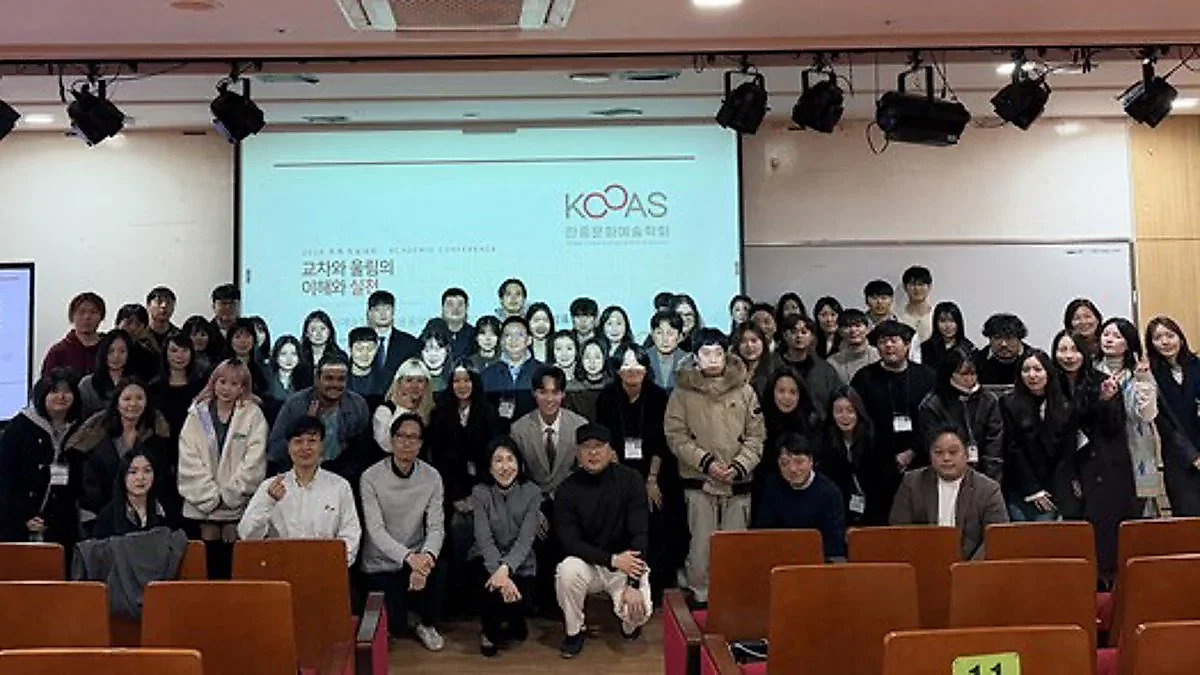
The Korea-China Culture and Arts Society and the Society for Applied Music, Culture and Technology held a conference at Sejong University on November 21, where eight papers were presented and the launch of the Society for Applied Music, Culture and Technology was announced.
The Korea-China Culture and Arts Society (President Lee Byeong-jun of Hongik University) and the Society for Applied Music, Culture and Technology jointly held the "2026 Autumn Conference" at the Daeyang AI Center B107 at Sejong University at 2:00 p.m. on November 21. This year's theme was "Understanding and Practicing Intersection and Resonance." The conference featured the presentation of eight papers across two sessions, followed by a designated discussion in the second part.
In the first session, "Discourse on Popular Music and Art," presentations included a comparison of singing styles and techniques of Korean and Chinese pop singers (Beom Hyo-gang of Kyonggi University Graduate School of Hallyu Culture), the structural generation mechanism of Ryoichi Kurokawa's digital art (Liang Lingyi of Kyonggi University Graduate School of Hallyu Culture), the visual identity of Korean indie bands (Noh Yoon-seo of Hongik University Graduate School of Performing Arts), and cultural mediation and Korea-China pop music exchange in the digital platform era (Kim Ji-hwan of Hongik University Graduate School of Performing Arts). Professors Lee Byeong-jun and Kim Hyeon-tae served as discussants.
The second session, "Applied Music Education and Vocal Practice," included presentations on the patterns of instructional language use in applied music vocal education (Lee Jeong-ha of Sejong University Graduate School of Convergence Arts), the educational use of recording (Park Seo-rang of Sejong University Graduate School of Convergence Arts), the pluralistic symbiosis and artistic expression of regional culture in Hunan, China (Ju Sin-ok of Hunan University of Information Technology), and an analysis of pitch stability in vocal learners following the application of vowel modification (Jeon Su-jin of Hanyang University Graduate School of Music and Fine Arts). Professors Yoo Jeong-yeon and Park Hong-jun served as discussants.
A distinctive feature of this conference was its simultaneous treatment of applied music through two layers: culture/arts and culture/technology. The former focused on cross-cultural intersections and their resonance, while the latter researched the conditions of production, education, and distribution that allow such intersections to occur. "Intersection is an event, and resonance is time," said President Lee Byeong-jun, adding, "What the society seeks to create is not a single grand meeting, but a long-lasting reverberation."
The launch of the Society for Applied Music, Culture and Technology was also announced during the conference. The society's articles of incorporation went into effect on July 4, setting three major tasks: publishing an academic journal with a review system, developing technical indicators for the fields of practice and production, and conducting joint research between industry and academia. Vice President Kim Hyeon-tae of Sejong University stated, "The long-standing weakness of applied music research is the absence of standards. It is impossible for an individual paper to establish standards, review based on them, and accumulate results."
The conference took place in conjunction with a turning point in Korea-China cultural exchange. During the Korea-China summit held in Shenzhen on November 18, both countries declared a substantive conclusion to follow-up negotiations on services and investment for the Free Trade Agreement, and China promised Most-Favored-Nation treatment in the film and game sectors as well as the principle of non-discrimination in content pre-screening. Domestic media interpreted this as a step toward lifting the Korean entertainment ban. Next year marks the 35th anniversary of the establishment of diplomatic relations between Korea and China.
The society plans to regularize Korea-China joint research and joint academic conferences, and to publish joint data collections that investigate curricula, acoustic standards, and distribution structures in both countries using identical items. A collection of the presented papers was distributed on the day of the conference, and information regarding membership and paper submissions is available on the society's website (https://kccas.co.kr/).

Covers K-pop for SPECIALTIMES GLOBAL, and also writes Culture and K-Variety stories.

Comments 0
Comments are currently disabled.