
Rising rents and shrinking housing push young people out of Seoul
Rising monthly rents in Seoul are forcing young people to move to surrounding provinces, leading to a shrinking residential footprint and a widening wealth gap.
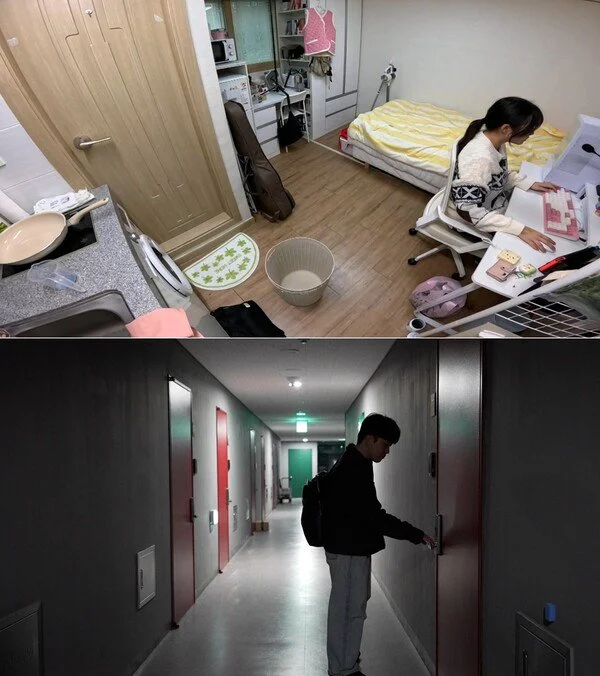
Increasing monthly rents and rising "jeonse" lease risks are driving young people out of Seoul, with 99,395 youth leaving the city between 2022 and 2023. In areas near Seoul National University, studio apartment rents surged 26% year-on-year to an average of 533,000 won this July.
While salaries remain stagnant, monthly rents are rising rapidly. For young people who lack large sums of savings and face anxiety over "jeonse" (lump-sum deposit) fraud, monthly rent is often the only remaining option. However, as rent prices soar faster than income, an increasing number of young people report having nothing left after paying their monthly housing costs.
A real estate agent who has operated in the Gwanak-gu area—a district with a high concentration of single-person youth households—for eight years stated that monthly rents for studio apartments (one-room) have risen by approximately 150,000 to 200,000 won in the last three years. While a studio apartment at a typical price point for young people could be found for 500,000 won three years ago, it now requires 600,000 to 700,000 won. Young people interviewed, earning monthly incomes between 2 million and 3 million won, were spending 25% to 30% of their income on housing. For those just entering the workforce, these rising rents represent an even greater burden.
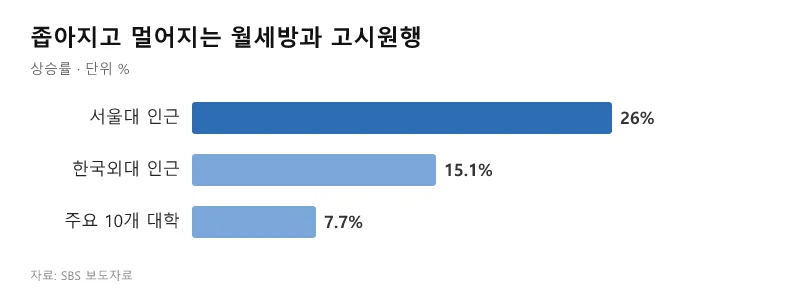
The rise in rents near university areas is not a new phenomenon. Demand for monthly rentals among youth has steadily increased as risks associated with "jeonse" leases—including fraud, "kkangtong" (equity-deficient) leases, and the failure to return deposits—have surfaced. According to the real estate platform Dabang, the average monthly rent for studio apartments near 10 major university areas in Seoul was 625,000 won in July. While the annual increase in August 2024 was only 0.2%, and the average rent in July last year was 581,000 won (actually lower than six months prior), the average jumped 7.7% year-on-year in July this year. Near Seoul National University, including areas like Sillim and Bongcheon, rents surged 26% during the same period, rising from 423,000 won to 533,000 won. Near Hankuk University of Foreign Studies, the average monthly rent for a studio in July was 670,000 won, a 15.1% increase from a year ago. According to the '2024 Housing Status Survey' by the Ministry of Land, Infrastructure and Transport, the homeownership rate for youth households was 12.2%, down 2.4 percentage points from 14.6% a year ago. The ratio of house prices to annual income stands at 6.0 times, with 16% of income spent on monthly rent and other housing costs.
Shrinking living spaces and the move to goshiwons
Lee Ji-hyeok, who moved to Seoul eight years ago for work, managed to endure by living in goshiwons and a rooftop room in Daebang-dong. However, after his sister, who shared the rent, got married and the landlord signaled a rent increase, he eventually moved to Bucheon, Gyeonggi Province. He now spends more than two hours a day commuting to Gangnam, where his workplace is located, and does not eat dinner until after 9 p.m. Young people who struggle to even secure a deposit are turning to goshiwons. Yoo Seung-chan, an aspiring bodybuilder, has lived exclusively in goshiwons, moving through Bucheon and Bundang before arriving in Gangnam. Though the rooms are so small that his arms touch the walls when outstretched, it is the only place he can afford to stay in Seoul to pursue his dream. Park Ji-eun, who also moved from the provinces, started her life in Seoul in a goshiwon. After combining savings from part-time jobs with help from her parents, she managed to secure a studio apartment, but one-fourth of her salary goes toward rent. Whether she can remain in Seoul after her two-year lease ends remains uncertain.
As more workers stay in affordable university areas after graduation, a phenomenon is occurring where university students are being pushed out. A third-year student at Hankuk University of Foreign Studies, who is preparing to return to school, moved into a dormitory in September after clearing out a studio apartment she had lived in for four and a half years. When the landlord announced a 100,000 won rent increase, she searched surrounding real estate offices for over a week but could not find a cheaper room. She noted that while there were originally vacancies in the men's dormitory, the current high cost of monthly rent makes it difficult to enter even if one wants to. A Soongsil University student, B, who moved into a boarding house near Sillim-dong earlier this month, said that while she tried to find a monthly rental, the options were limited as most suitable places exceeded her budget. According to the Seoul Metropolitan Government, the number of goshiwons in Seoul increased from 5,115 in 2024 to 5,180. In the Sinchon area, the number grew from 114 in 2022 to 121 last year.
| Region | Previous Year Avg Rent | This Year Avg Rent | Increase Rate | Additional Info |
|---|---|---|---|---|
| Near Seoul National University | 423,000 won | 533,000 won | 26% | Includes Sillim, Bongcheon, etc. |
| Near Hankuk University of Foreign Studies | Not listed | 670,000 won | 15.1% | Imun-dong area, Dongdaemun-gu |
| 10 Major University Areas | 581,000 won | 625,000 won | 7.7% | Avg management fee 84,000 won |
Youth leaving Seoul and the burden of housing costs
As living in Seoul becomes more difficult, an increasing number of young people are moving to areas such as Gyeonggi Province and Incheon. According to Seoul youth statistics, 99,395 young people left Seoul over the two-year period from 2022 to 2023. Last year, the age group with the highest net outflow from Seoul was those in their 30s, accounting for 58% of the total. For those aged 35–39, the number one reason for moving out was housing, at 31.7%. According to KB Real Estate, the ratio of house prices to income in Seoul was 11.3 at the end of last year. Compared to the end of 2014, the time required to afford a home has increased by 3 years and 3 months, while house prices have more than doubled. The proportion of youth-occupied housing that consists of apartments decreased from 29% to 26%, while the proportion of non-apartment housing, such as goshiwons and officetels, increased from 11% to 18%. Between 2014 and 2024, the youth population in Seoul registered under resident registration decreased by 13%, whereas the population in Gyeonggi Province decreased by only 2%.
Kim, a former Seoul resident who moved to Incheon, said she had lived in a house in Nowon-gu with a 10 million won deposit and 500,000 won monthly rent after becoming independent, but when the landlord sought to raise the rent, she found other studio apartments in different neighborhoods were 800,000 won, which pushed her toward Incheon. Another worker from South Gyeongsang Province living in Seoul, Kim, expressed feeling a sense of futility after paying rent for five years, noting that while friends from her hometown were buying cars and larger homes, she felt she was merely treading water. The Seoul Metropolitan Government has made increasing the supply of housing, including Youth Safe Housing and long-term jeonse, a top priority. From 2020 to the end of June this year, the city completed 77 Youth Safe Housing complexes totaling 25,260 units for youth and newlyweds. As Youth Safe Housing provides units near subway stations at prices lower than market rates, demand has exploded, with the average competition rate for the first recruitment in 2025 reaching 146 to 1.
Wealth gap and the limits of countermeasures
Most of the young people interviewed moved to Seoul from the provinces to find work and pay hundreds of thousands of won in monthly rent every month. They expressed feeling an invisible wall when seeing peers who commute from their parents' homes and are able to save their salaries. They live with the anxiety that this gap will only widen over time. Choi Eun-young, director of the Korea Center for City and Environment Research, emphasized that youth housing support has been designed as something to be done for only one or two years, and stressed that a world must be created where the right to housing—allowing for a comfortable life even when renting—is guaranteed. Experts point out that urgent alternatives for affordable housing must be provided for the youth, along with increased housing cost support.
However, critics argue that current measures are insufficient to immediately improve the poor housing environments of university students and young people. This is due to backlash from the youth demographic, who have criticized the measures as "desk administration."
SBS News Story broadcasts at 8 a.m. on Saturday the 28th.

Covers K-pop for SPECIALTIMES GLOBAL, and also writes Culture and K-Variety stories.



Comments 0
Comments are currently disabled.