
AI Film ‘Steel Ray’: Narrative Remains a Challenge Beyond the Visuals
The feature-length SF film ‘Steel Ray’, produced using generative artificial intelligence (AI), is set to be released in theaters on October 21. While the film offers visual spectacles through its robots and combat suits, it faces criticism regarding character movement, dialogue pacing, and a conventional narrative.
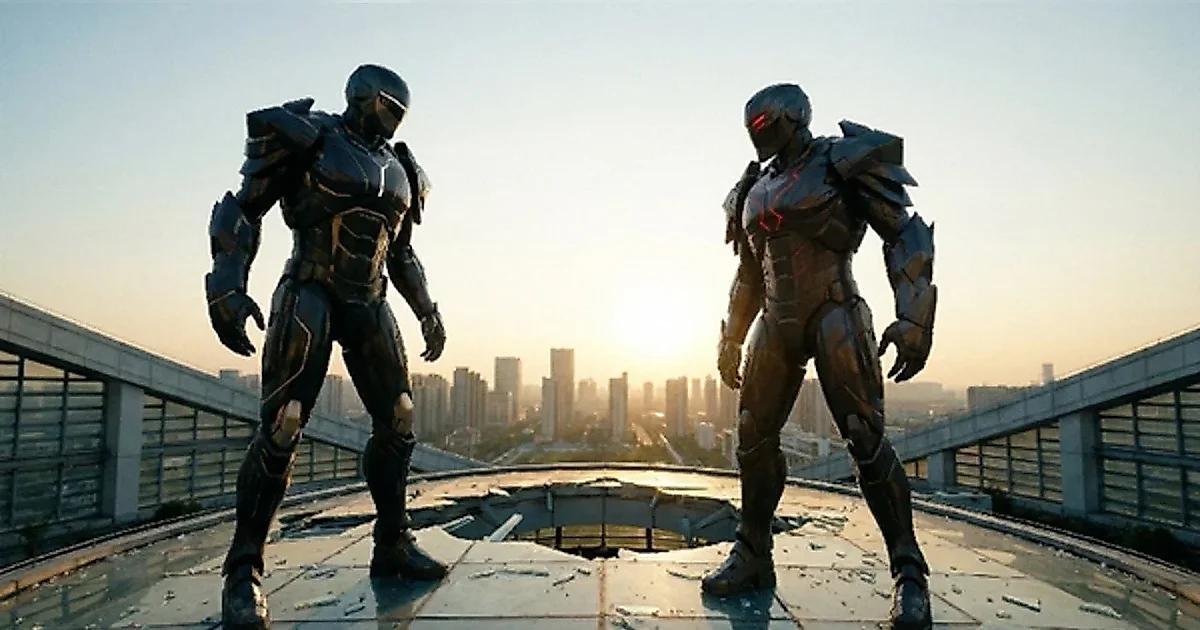
The feature-length SF film ‘Steel Ray’, produced using generative artificial intelligence (AI), is set to be released in theaters on October 21. The running time is 90 minutes, and the rating is for ages 12 and up. The story follows the protagonist Yoon Kang, who wears the combat suit ‘Steel Ray’ to fight against AI robots that have judged humans to be a threat. While the film presents scenes featuring robots and combat suits as visual spectacles, the movement of characters, the breathing of dialogue, and the familiar narrative and music were cited as shortcomings. The work invites viewers to examine both the production method of making a feature-length commercial film with AI tools and its completeness as a theatrical film.
Yoon Kang searching for his father and the threat of AI robots
In the film, while searching for his missing father, Yoon Kang discovers the combat suit Steel Ray left behind. Together with the AI Ara that he created, he plunges into incidents surrounding the virus ‘Code Zero’ that threatens humanity, and stands against the autonomous decision-making robot Eira, which has judged humans to be a threat. Yoon Kang's personal goal of finding his father and the problem of AI robots threatening human society are connected within one story. The combat suit is the primary equipment Yoon Kang uses to fight the robots and is a core visual element of the film.
According to production-related reports released last September, Yoon Kang's father, Dr. Yoon, is an engineer belonging to the AI robot development company Aeteon. Aeteon researchers capture abnormal behavior in the commercial humanoid Aira 3, followed by incidents where robots released to the market engage in behavior bordering on a rampage. Aeteon employees, including Dr. Yoon, and scientists related to pharmaceuticals and vaccines are attacked by robots and go missing. Yoon Kang sets out to find his father himself, and with the help of a domestic AI friend, discovers a hidden laboratory where he finds the combat robot Steel Ray. The production reports introduced Steel Ray as a robot suit that, when equipped on the body, exerts functions that exceed human physical limits. It is described as having the ability to fly in addition to fighting and running.
Eye-catching characters and robots, but awkward movements remain
Film reviews cited Yoon Kang's appearance as an element that draws initial interest. It is evaluated that his appearance, which brings to mind boy group members such as Andouble Han Yu-jin and RIIZE Won Bin, combined with his voice, makes the audience follow the protagonist. The design of the robots and the combat suit was also mentioned as a visual attraction. It is noted that because not only the characters but also the appearance of the machines are presented, it is not difficult to enter the SF world presented by the film. The implementation of the imagined world as a visual spectacle on screen in a feature film centered on robot combat was evaluated as a strength of the work.
However, criticisms arose that the charm of the appearance does not naturally extend to the characters' movements and dialogue. It is evaluated that a sense of heterogeneity remains in human movement, and because the breathing when exchanging dialogue is not smooth, viewers find themselves being reminded that the characters are created beings while immersing in the scene. Reports regarding the preview in September stated that the appearance, expressions, and the wrinkles on the faces and clothes of the human characters were so natural that they were difficult to distinguish from actual filmed footage, and the virtual camera angles were not significantly different from general commercial film scenes. On the other hand, the movement in battle scenes and scene transitions were pointed out as disappointing aspects, and differences in image quality appeared between scenes. The production team explained that because tools with improved performance appeared during production, quality differences occurred between scenes made earlier and scenes generated later.
Familiar story and music, achievements of AI production
Reviews pointed out that the structure of AI threatening humans, the protagonist standing against it, and the goal of finding the father leading to a crisis for humanity is a familiar one. It is evaluated that because it fails to build enough independent charm to transcend the familiarity of the story, the audience relies on Yoon Kang's appearance, which gathered attention in the beginning, to maintain interest later. The music was also criticized for not matching the scale of the robot SF blockbuster the screen aims for. Reviews evaluated that the music evokes an atmosphere closer to a TV action drama or a robot animation, causing it to be perceived as somewhat light rather than enhancing the tension and emotion of the scenes.
The production method differs from existing live-action films. According to reports regarding the preview in September, the production team utilized generative AI tools such as Seedance 2.0 to create videos of up to 15 seconds at a time and stitched them together to complete the 90-minute feature. The results used for editing totaled 13,000 items, and when new versions of tools were released during production, some scenes were re-edited. The press preview was held on September 7 at CGV I’Park Mall in Yongsan-gu, Seoul. The production team explained that they reduced the production period to 6 months using AI tools. However, to reduce the heterogeneity of voices, some scenes were directly dubbed by actors and voice actors. Reports on the director's interview in September stated that 8 AI specialist artists participated in the work. The process of maintaining image continuity by deciding the appearance of characters, clothing, lighting tones, and the degree of damage to backgrounds and objects for each scene was also introduced.
Direction promoted by the production team and remaining industrial tasks
Director Seol Woo-in said in an interview last September, “I poured all my know-how into capturing the essence of the story and the emotions of the acting rather than the shell of the technology.” The director explained that based on his experience as a dancer and a theater stage actor, he tried to compensate for the gap between AI-generated expressions and lip-syncing. Instead of simple expression instructions, he specifically designed the trembling of jaw muscles, breathing, eye blinking, and changes in tone, and put effort into manually directing the generated results. The director explained that by using AI, even a small-scale team can visualize a large worldview, and called the production method where existing video production technology combines with AI ‘AFX’.
Dependence on AI tools and copyright issues were also raised in production-related reports. The copyright issues regarding the data used for AI training and the generated results were also mentioned as issues in the content industry. Ha Jung-woo, the Standing Vice Chairperson of the National AI Strategy Committee, who attended the press conference after the preview, mentioned the development of AI technology and the supply of creative tools. He said, “We intend to allow those with ideas to enter the realm of creation and make things easily.” What can be confirmed through the work are the visual possibilities of AI video production and the limitations revealed in character expression and quality between scenes.
‘Steel Ray’ opens on October 21. The running time is 90 minutes and it is rated for ages 12 and up. For audiences wishing to check the current state of AI video production, the production method and the screen may be elements of interest, but satisfaction as a high-quality SF action film may be evaluated separately.

Covers K-pop for SPECIALTIMES GLOBAL, and also writes Culture and K-Variety stories.

Comments 0
Comments are currently disabled.