
'The City of Violence' Revisited After 20 Years... Ryoo Seung-wan Reveals Production Behind-the-Scenes
Director Ryoo Seung-wan and action director Jung Doo-hong attended the 'Master Talk' at Community BIFF to watch and provide real-time commentary on the film 'The City of Violence' for audiences. They shared stories regarding casting, budget constraints, and specific scene changes during the session.
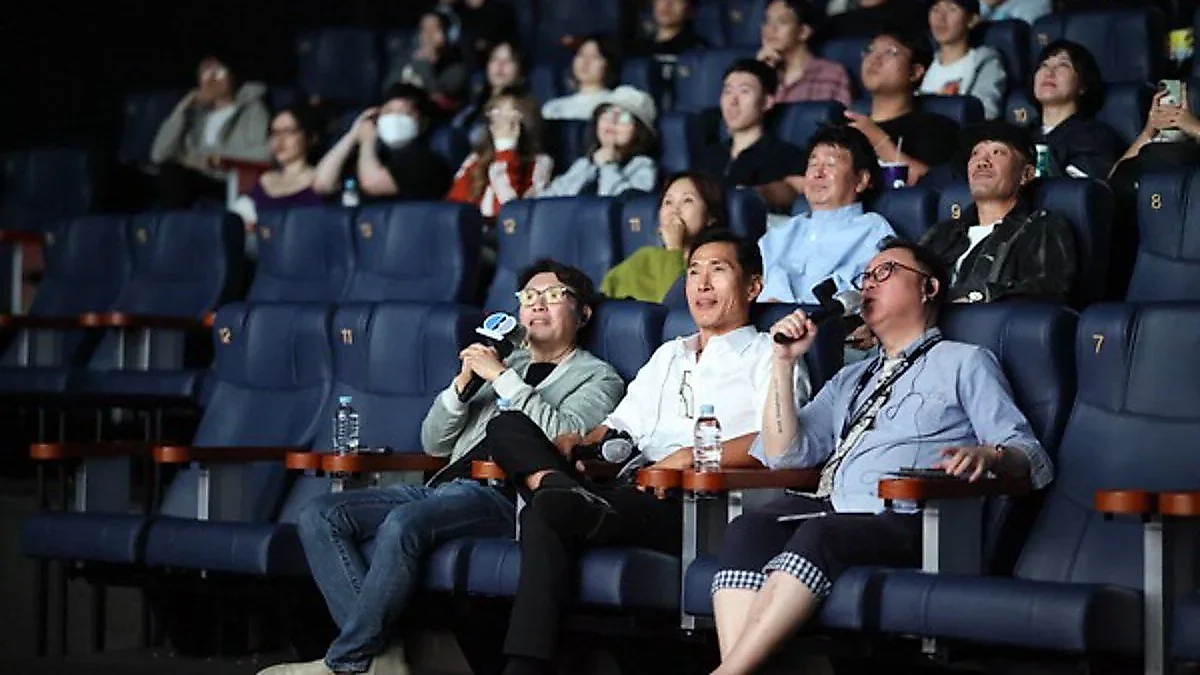
The film 'The City of Violence' met with audiences at the Busan International Film Festival for the first time in 20 years since its release. On the 9th, Director Ryoo Seung-wan and action director Jung Doo-hong attended the 31st Busan International Film Festival Community BIFF 'Master Talk' held at Megabox Busan Theater Theater 1. While watching the film with the audience, they provided real-time commentary on the filming site, casting, and scenes that were changed due to budget issues. Unlike the typical Guest Visit (GV) held separately after a screening, 'Master Talk' is a program where the director or actors provide commentary while watching the film. The two recalled their choices and work experiences for each scene, while the audience listened to the explanations through receivers and posted questions in a chat room accessed via QR codes.
Real-time commentary following the film
'Master Talk' is a program that can be found at Community BIFF, rather than in Haeundae, where invited works of the Busan International Film Festival are mainly screened. It has been actively introduced and continued by Cho Won-hee, the chairperson of the Community BIFF organizing committee. Unlike a GV where conversations take place after the film ends, the director or actors watch the film with the audience and provide commentary in sync with the scenes. Through receivers worn in their ears, the audience can hear filming episodes and unknown behind-the-scenes stories, and they enter questions that come to mind in real-time into a group chat room entered via QR code. The chat content is displayed on the screen together, allowing the entire audience to share questions and reactions.
During this screening, the chat window moved in sync with the scenes in the movie and the on-site explanations. In a scene where Jung Doo-hong, playing the role of Tae-su, acts as if he is drunk, Community BIFF chairperson Cho Won-hee looked at Jung Doo-hong's back and said, "No, Director Jung Doo-hong, looking only at your back, you're almost like Lee Byung-hun from Chungcheong Province?" Jung Doo-hong replied, "Ah, it was really hard back then. I was acting like I was truly drunk." The audience sent questions to the chat room and saw other audience members' comments as well. Rather than a format where explanations are heard after the film ends, the event continued with a structure where filming circumstances were confirmed at the moment the scenes were progressing.
From the setting of Onseong to casting behind-the-scenes stories
'The City of Violence' is a work released in May 2006, telling the story of Seok-hwan, played by Director Ryoo, and Tae-su, played by Jung Doo-hong, who discover the evil deeds of another friend while investigating the death of a friend. The hometown of the two protagonists is the fictional tourist village of Onseong. It is a place name created by combining the names of Onyang and Yuseong, as Director Ryoo is from Chungcheong Province. Regarding the name Tae-su, Director Ryoo revealed, "Tae-su is a name I chose because I like the drama 'Sandglass'." The role of Pil-ho, who drives those around him to misery with twisted inferiority complexes, was played by actor Lee Beom-soo. Director Ryoo explained that Lee Beom-soo was not on the casting list from the beginning. He said, "Since it was a movie with a small budget, I didn't even think about it. Fortunately, it happened because he liked my movie."
When the actors playing the protagonists' teenage years appeared on screen, Director Ryoo also shared the process of casting Kim Si-hoo, who played Seok-hwan's childhood. Director Ryoo said he cast Kim Si-hoo after watching the film 'Lady Vengeance'. He also introduced an anecdote where Director Park Chan-wook said, "Does it make sense for Si-hoo to grow up to be you?" after seeing the appearances of Kim Si-hoo and Director Ryoo. Regarding the genre reference works that formed the basis of the film, he pointed out scenes that show the influence of directors he likes, such as Brian De Palma and Sam Peckinpah. Regarding 'The City of Violence', Director Ryoo said, "I wanted the movie to be a cinematic movie," and "I tried to contain everything I like."
'The City of Violence' is also a work where Director Ryoo's attempts at action spectacles are concentrated. Regarding a scene where the characters in the movie continue to the next action even after being seriously injured in a fight, a question was posted in the chat room: "Why don't they go to the hospital?" Reading this, Director Ryoo said, "Seriously, why didn't I think about going to the hospital?" which drew laughter from the audience. He explained that he likes to emphasize the sound of footsteps, and an audience member wrote in the chat window that footstep sounds also appear in 'HUMINT', which was released earlier this year. Following the scenes of the movie, Director Ryoo also added comments regarding choices made for sound and directing.
Action filming involving blue tape and signs
The two directors also revealed the physical burden and preparation process experienced while filming action scenes. The more a group action scene looks like a wild brawl on the surface, the more thorough preparation was needed in advance, and the two pushed themselves mentally and physically for the filming. There were even times when they wrapped their bodies with blue tape to prevent blood from flowing. While watching an action scene, Director Ryoo recalled, "Ah, at that time, Director Jung Doo-hong hit his face against a sign." Explaining that in a scene filmed in a back alley of Cheongju, the wall and the size of the space did not match, he said, "This is a scene filmed in a back alley of Cheongju. The size of the wall and the size of the space did not match. Ah, it would have been better if the wall were a bit larger."
Regarding the scene where a gang of teenagers is buried in the ground with only their necks showing, another story related to filming came up. Director Ryoo said, "There was a staff member who was actually buried like that." A comment was posted in the chat room saying, "Just what kind of life have you lived?", and laughter erupted in the audience. Regarding the setting in the movie where Pil-ho conducts underwater burials of villagers in a reservoir, Director Ryoo also shared the scene he had originally envisioned. He explained that he wanted to show a scene where numerous corpses were piled up deep under the water of the reservoir. He said that doing so could have revealed how many evil deeds Pil-ho had committed, but because the budget was low at the time, he could not capture it as envisioned.
Scenes and endings changed due to budget}
The ending originally thought of was a scene where, amidst a festive atmosphere among the villagers following the news that the village had been designated as a special tourist zone, Tae-su, who was being carried in an ambulance, was slowly dying. Director Ryoo said, "The original concept was a scene where Tae-su, being carried in an ambulance, was slowly dying amidst a festive atmosphere as news arrived that the village was designated as a special tourist zone. Even just hearing it, it sounds like it would cost a lot of money." While explaining the scenes actually included in the movie alongside the remaining concepts, he conveyed the situation where the cost at the time of production influenced the scale and composition of the scenes.
'The City of Violence' was the only Korean film that year to be invited to the Midnight Section of the 63rd Venice International Film Festival. During the event, recalling the time of the Venice screening, Director Ryoo said, "There was a loud round of applause for this scene in Venice." At the time, the film received evaluations such as "a movie that stimulates adrenaline secretion" and "it feels like watching a movie from Jackie Chan's heyday." While watching the scenes of the film, Director Ryoo also pointed out the influence of directors he likes, such as Brian De Palma and Sam Peckinpah. The explanations regarding the fights in the movie, the filming site, and the concepts changed due to the budget continued while receiving questions from the audience and chat reactions.
After finishing the screening and commentary, Jung Doo-hong said, "It's time for the joints to lose their lubrication, but I will still do my best happily and hard." Director Ryoo stated, "I have a wish that my movie would be a movie that survives through time, and I was also grateful to see my colleagues' grown appearances like this." He then greeted the audience, saying, "I will continue to make movies hard. I will contemplate what kind of path can become a stepping stone for young filmmakers to open new ways. Thank you very much."

Covers K-pop for SPECIALTIMES GLOBAL, and also writes Culture and K-Variety stories.

Comments 0
Comments are currently disabled.