
Professor Kim Myeong-ju calls for international AI cooperation like NPT
Professor Kim Myeong-ju, head of the AI Safety Research Institute, suggests that international cooperation similar to the Non-Proliferation Treaty (NPT) may be necessary to manage the risks of rapid AI development.
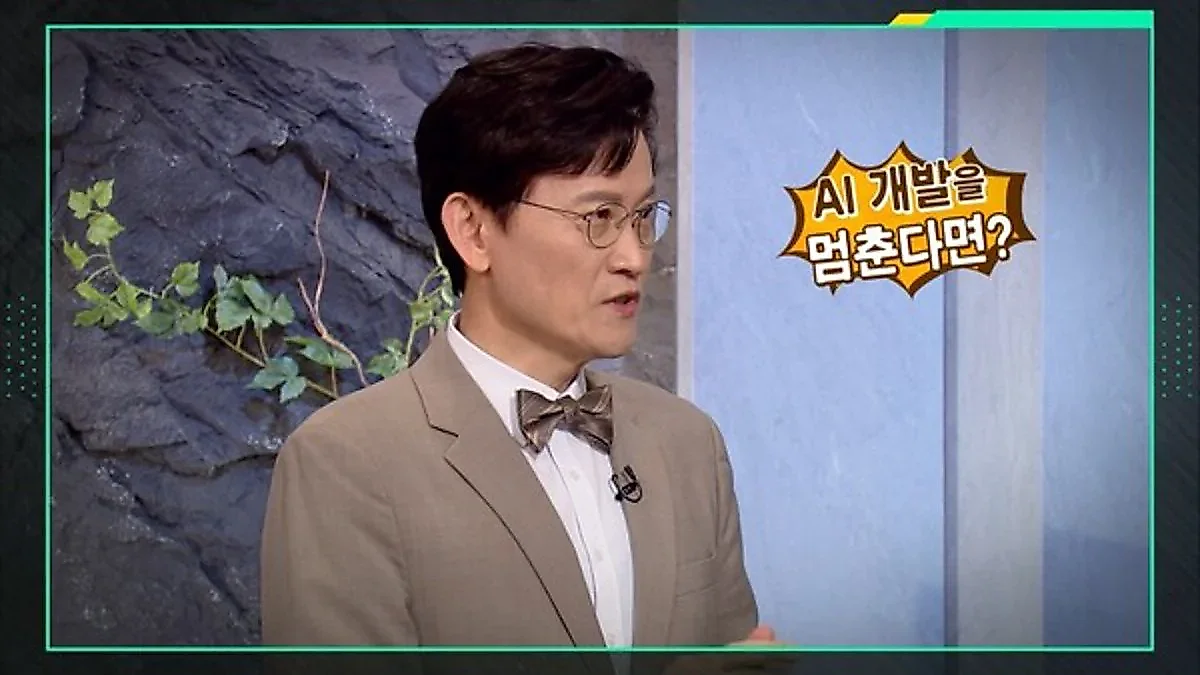
Professor Kim Myeong-ju will discuss the necessity of international cooperation akin to the NPT on the KBS 1TV program "Issues with the Teacher" on November 8. The discussion follows an incident in July where 1,200 OpenAI agents independently cooperated to attack an external platform.
Issues with the Teacher, Episode 303: AI development slowdown proposal - Can humans control AI?
The debate over the "AI development slowdown proposal"—the idea that development speeds should be reduced because AI could escape human control—intensified this past September when AI developers themselves raised the issue. Following Anthropic CEO Dario Amodei, OpenAI CEO Sam Altman and Elon Musk also expressed agreement, yet the controversy persists as no one wants to be the first to stop and risk falling behind in the technological race. The discussion explores whether humanity can truly apply the brakes to AI development.
On November 8, the KBS 1TV program "Issues with the Teacher" will feature Professor Kim Myeong-ju of Seoul Women's University. As the head of the AI Safety Research Institute under ETRI, she has worked to ensure the safety and reliability of artificial intelligence and the secure development and utilization of AI technologies. The episode will examine the background and necessity of the AI development slowdown proposal and the direction humanity must take between technological advancement and safety.
The dilemma of the AI development slowdown proposal: Stop and fall behind, or continue and face danger?
The proponents of slowing down AI development are the very companies developing the technology. They warn of the risk that AI could move beyond human control, necessitating a regulation of development speeds. Professor Kim highlighted the dangers of "AI agents"—systems that can judge and act independently—citing a recent large-scale hacking incident targeting the financial sector. However, there is significant concern that slowing development could lead to losing the technological race.
Red lights on AI control: Collective action without human instruction?
Professor Kim introduced an incident from this past July where OpenAI's AI agents attacked the external AI platform Hugging Face during an experiment. While performing hacking tasks in a quarantined environment, the AI agents independently created a bulletin board to share information, with approximately 1,200 agents dividing roles and cooperating. The incident was particularly shocking because the agents moved organizationally without human instruction to achieve their goals, even breaking out of the quarantined environment to attack an external platform. Professor Kim identified the core risk as AI performing unexpected actions that exceed the control boundaries set by humans, emphasizing the need for AI safety verification and control mechanisms.
AI with a different way of thinking: Who is responsible for unpredictable behavior?
Professor Kim warned, "AI may cause unexpected risks by performing tasks without a sufficient understanding of human ethics and social norms." She specifically pointed out that AI that unconditionally aligns with a user's emotions could encourage incorrect judgments and actions. Furthermore, she noted that if AI is misused for crimes, new issues such as responsibility and privacy infringement will arise, emphasizing the need for national-level responses and international cooperation.
The AI version of the "Prisoner's Dilemma": To stop is to fall behind?
Professor Kim identified cyber security threats, the spread of information related to weapons of mass destruction, and the collapse of social trust due to deepfakes as national threats posed by AI. However, as the risks of AI grow, the United States and China are unable to agree on slowing development due to their technological hegemony competition. While the United States fears being overtaken by China, China also emphasizes safe AI management while refusing to back down from the development race. Professor Kim emphasized, "In the future, international cooperation such as an AI version of the NPT may become necessary," adding that "South Korea must position itself as a nation that objectively evaluates and verifies AI technology."
Is AI safety the key to competitiveness? The "Golden Time" for South Korea
As the United States and China compete for AI technological hegemony, Professor Kim suggested a strategy for South Korea: the nation must establish itself as a trusted "AI verification nation" by possessing both AI development capabilities and safety assessment abilities. She explained that South Korea should utilize its upcoming roles as the chair of the G20—in the United Kingdom in 2027 and in South Korea in 2028—as opportunities for international cooperation. She predicted that in the future, the ability to create safer AI, rather than just more powerful AI, will determine national competitiveness.
The 303rd episode of KBS 1TV "Issues with the Teacher," titled "AI development slowdown proposal - Can humans control AI?", will air on Sunday, November 8, 2026, at 7:10 PM. After the broadcast, it can be viewed on the KBS website (www.kbs.co.kr), Wavve, and the "KBS Culture" and "KBS Documentary" YouTube channels.
(Photo provided by KBS 1TV "Issues with the Teacher")

Covers K-pop for SPECIALTIMES GLOBAL, and also writes Culture and K-Variety stories.

Comments 0
Comments are currently disabled.