
Tenor Choi Mun-yeong begins teaching vocal music after five years of gold wins
Tenor Choi Mun-yeong, a singer with severe intellectual disabilities, has achieved five consecutive national gold awards by memorizing music entirely by ear and is now stepping into a new role as a vocal assistant for junior musicians.
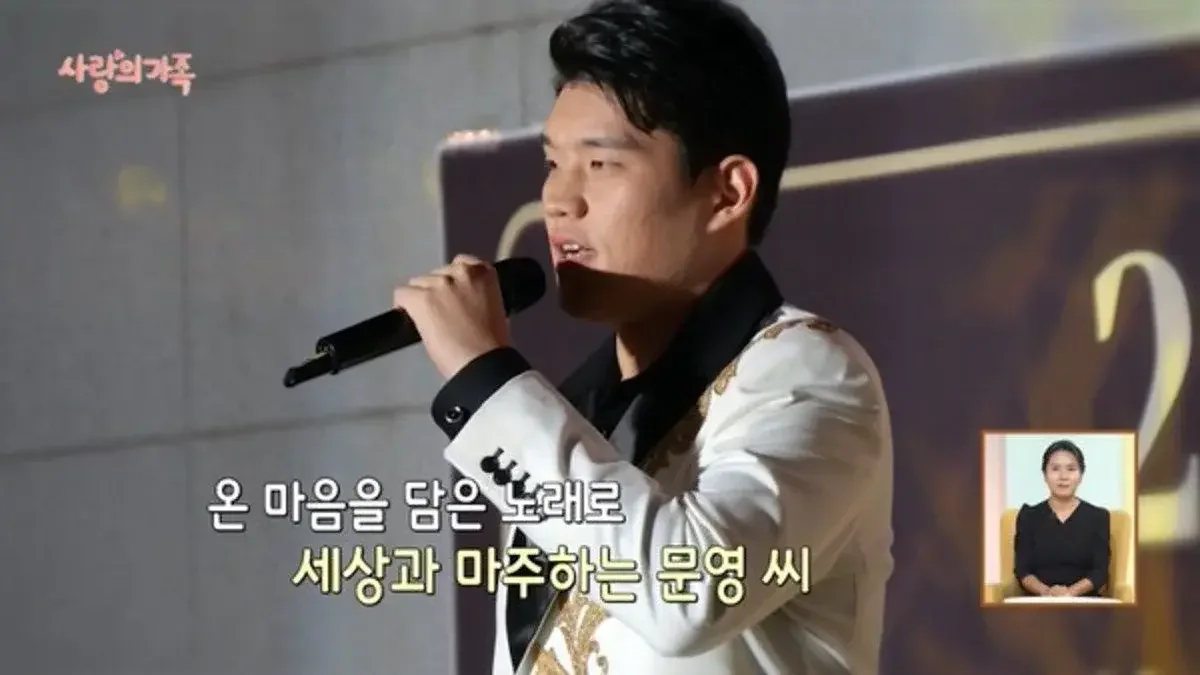
Intellectually disabled tenor Choi Mun-yeong, who has won national gold for five consecutive years by memorizing music by ear, has started serving as a vocal assistant for junior musicians with developmental disabilities.
Family of Love Episode 3141
Memorizing by ear to win national competition gold for 5 consecutive years... Intellectually disabled tenor Choi Mun-yeong takes on the challenge of becoming a 'vocal assistant.'
Outdoor fitness spaces in parks are "pie in the sky" for wheelchair users... What are the practical directions for improvement?
Broadcast: Saturday, November 7, 2026, at 11:10 AM on KBS 1TV
The harmony of a tenor son and his devoted mother, the "Beautiful People."
In Gwangjin-gu, Seoul, live Choi Mun-yeong, a tenor with severe intellectual disabilities, and his reliable supporter, his devoted mother Hong Su-hui. Although Choi was diagnosed with an intellectual disability at age 4, he began studying vocal music at age 7 with the support of his mother, who discovered his extraordinary musical talent.
Because he cannot read sheet music, he has put in grueling effort to memorize every song entirely by ear. This dedication resulted in winning gold at national competitions for five consecutive years during his school years and graduating from a regular university music department with a major in vocal music. He currently performs as a professional singer as a member of the Miracle Voice Ensemble, a mixed choir for people with developmental disabilities, performing on various international stages including Japan, the United States, and Europe.
Choi's ability to stand confidently on stage as a tenor is due to the silent support of his family. His mother, who began her activities with the Parents' Solidarity for Persons with Disabilities following her son's experience as a victim of school violence during elementary school, currently serves as the chairperson of the Center for Independent Living of People with Developmental Disabilities to help other families of persons with disabilities. His younger brother, Jin-yeong, also works as an activist at the center, sharing the same mission.
On performance days, his mother transforms into a devoted manager, meticulously handling his hair, makeup, and stage costumes. As the stages grow larger, the pressure regarding potential mistakes follows, but for Choi, the time spent singing remains his most free and happy moment. Knowing her son's heart, his mother cannot let go of her role as a manager even amidst her busy schedule.
Recently, he has taken on a new challenge as a "vocal assistant" to teach junior musicians with developmental disabilities who, like him, dream of music. He has become a reliable senior to aspiring vocalists preparing to join the Miracle Voice Ensemble, demonstrating vocalization techniques and teaching the vocal skills he has mastered through experience. This follows the warm journey of tenor Choi Mun-yeong, who wishes to convey warm comfort to the world with his voice, and his mother, who silently supports her son's singular path in vocal music.
"Going to the End": People in wheelchairs also want to exercise outdoors
Outdoor exercise equipment installed in national parks and walkways is a representative piece of lifestyle sports infrastructure that anyone can enjoy for free. However, due to structures centered around non-disabled people, such as high-threshold entrances and fixed seating, these facilities remain "pie in the sky" for wheelchair users.
Although parks are the exercise spaces most frequently visited by persons with disabilities in their daily lives, they continue to be marginalized from lifestyle sports due to a lack of accessibility. In this segment of "Going to the End," the program investigates the current state of accessibility for persons with disabilities who cannot even use outdoor exercise facilities with peace of mind. Following this, the program will visit a park equipped with "barrier-free exercise equipment," which has emerged as a new alternative, to experience it firsthand with a disability sports instructor and seek practical directions for improvement to create an outdoor lifestyle sports environment without discrimination.

Covers K-pop for SPECIALTIMES GLOBAL, and also writes Culture and K-Variety stories.
Comments 0
Comments are currently disabled.