
Superfans drive content growth through active participation, says Fan Communications Global
Fan Communications Global, operator of the global fandom support platform JK Fandom, presented a new fandom business direction centered on super-fan economics and fan data at CONTENTS UNIVERSE KOREA 2026.
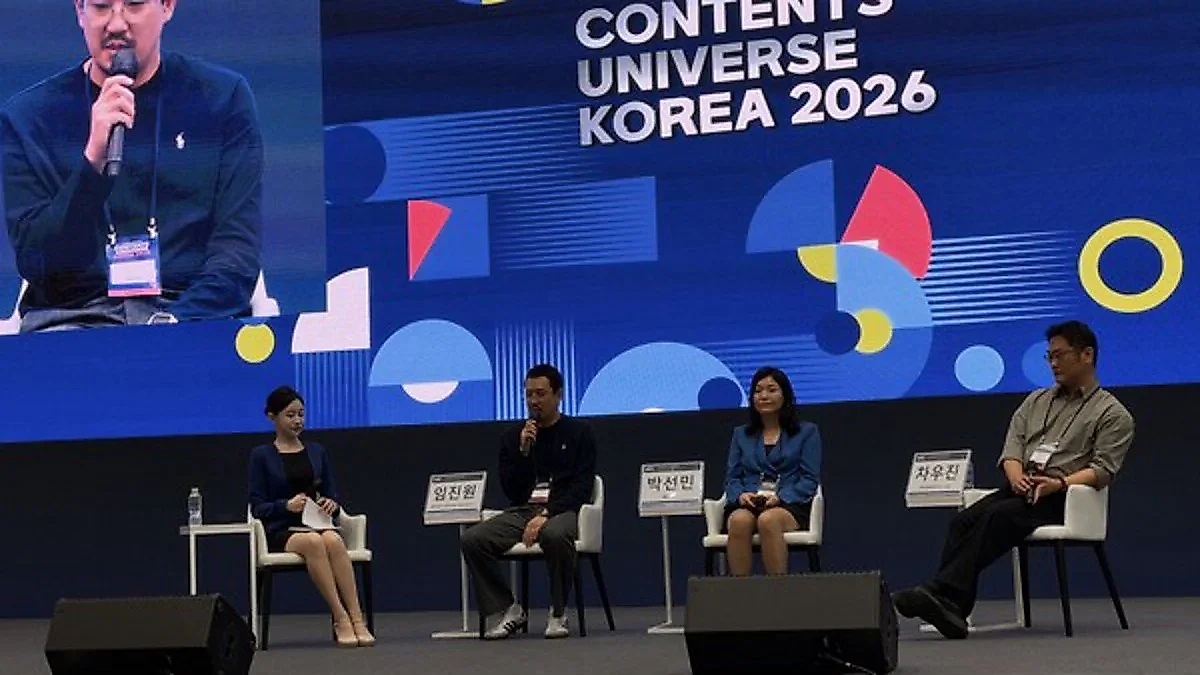
At CONTENTS UNIVERSE KOREA 2026 in Goyang, Fan Communications Global director Im Jin-won explained that super-fans drive content growth through actions like voting and purchasing rather than mere consumption. The company aims to use behavioral data from these active minorities to create a circular structure that attracts new fans to existing IP.
Fan Communications Global (CEO Tetsuya Endo), which operates the global fandom support platform JK Fandom, presented a fandom business direction centered on super-fan economics and fan data at CONTENTS UNIVERSE KOREA 2026, held on the 16th at the Goyang Flower Exhibition Hall in Ilsan Lake Park, Goyang, Gyeonggi Province. During the presentation, the company introduced the perspective that fans are no longer mere consumers of content, but the primary agents driving its growth.
The event, hosted by the Goyang International Exhibition Foundation and Edaily, was held under the theme of "Content Economy." Im Jin-won, director of Fan Communications Global, participated as a speaker in the Fandom Economy session alongside Park Seon-min, CEO of Ollim, and Cha Woo-jin, CEO of Neo Vibe Lab, presenting on the topic "Fans are not consumers - The new content economy created by Superfans."
Superfans are defined by "action" rather than "heart"
Director Im Jin-won defined a super-fan not as someone with a "big heart," but as someone with "much action." He explained that while a viewer who watches content once remains a spectator, a person becomes a super-fan by accumulating actions such as voting, purchasing, participating, spreading, and creating.
He noted that fans are not consumers who merely watch content, but active individuals whose actions drive the growth of that content.
Differences between South Korean fandom and Japanese Oshikatsu; the essence remains "support"
The presentation also addressed differences in fan culture between South Korea and Japan. While South Korean fandom culture involves moving together to create records, such as first-week sales or music show voting, Japan's Oshikatsu is a culture of supporting a favorite individually every day in daily life. Im Jin-won stated that although the forms differ, the reason fans spend money and time is for "support" rather than "consumption."
The "active minority" creates results; fans are to be "read," not "managed"
A case study of global fan voting operated by JK Fandom was introduced. Although fans from all over the world participated, it was a small number of super-fans who produced the results. Im explained that both voting and sales come from the "active minority" rather than the entire fan base.
He emphasized that the future content industry must view fans as "partners who grow IP together" and fandoms as the "starting point of planning," stressing that fans should be "read" rather than "managed."
"Will not remain a simple voting app"... Vision for a circular structure based on fan data
During the Q&A session, a question was raised regarding whether reliance on super-fans could be a risk as well as a growth engine. In response, Im Jin-won stated that JK Fandom will not remain a simple voting app.
The vision is to create a circular structure that does not rely solely on specific super-fans by using the sales and behavioral data left by super-fans to create new content and events, which in turn leads to the influx of new fans and the expansion of the fan base.
Based on the data and expertise accumulated through operating fan voting and fandom policies in South Korea and Japan, Fan Communications Global plans to expand collaborations with IP holders, entertainment agencies, and platform operators.
“From the perspective of developing fandom business using fan platforms, this presentation was a very meaningful experience from the preparation stage,” Im Jin-won said. “The core of fandom business lies not just in gathering fans, but in understanding the actions and data they leave to connect them to new content and events, which then leads back to fan influx and growth.”
He added, “JK Fandom also aims to go beyond a simple voting platform toward a virtuous cycle where fan support creates new opportunities and content, which then returns to the fans. Through this presentation, I have gained even greater conviction and a sense of responsibility regarding this direction.”

Covers K-pop for SPECIALTIMES GLOBAL, and also writes Culture and K-Variety stories.
Comments 0
Comments are currently disabled.