
3 Weeks Since the Revised Public Performance Act Took Effect: Effectiveness of Eradicating Scalped Tickets and Remaining Challenges
Since the revised Public Performance Act took effect on August 28, institutional regulations against scalped concert tickets have been strengthened.
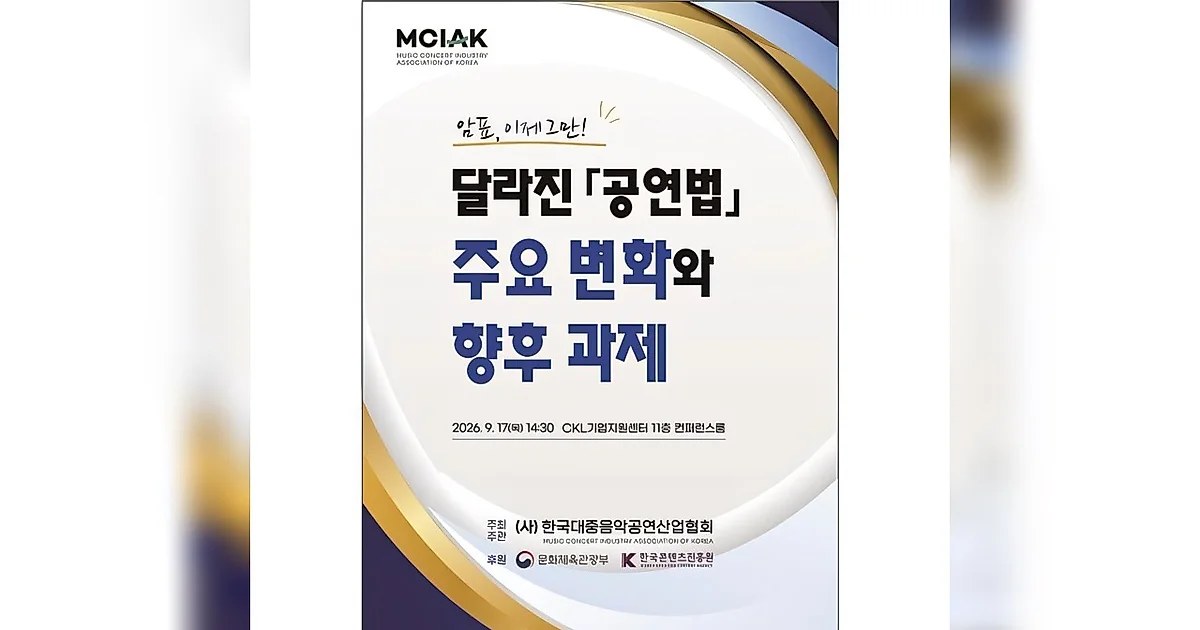
With the revised Public Performance Act taking effect on August 28, institutional regulations against scalped concert tickets have been further strengthened. Measures to eradicate scalped tickets have been established, such as broadly regulating unfair purchases and sales regardless of whether macros were used and introducing a reporting reward system. The necessity of the legal revision was further emphasized by a recent case that sparked public outrage, in which a man in his 30s was caught on suspicion of purchasing 8,967 tickets for popular performances and sports matches from September 2018 to April this year and reselling them for 2.4 billion won with markups of up to 30 times the original price. It was investigated that the man used the criminal proceeds to purchase one apartment and two commercial buildings located in Gyeonggi Province.
Now, about three weeks after the law took effect, the performance industry, investigative agencies, and ticketing platforms are busy preparing countermeasures. The Korea Popular Music Performance Industry Association is strengthening monitoring at performance sites, and ticketing platforms have taken technical measures, such as blocking abnormal access and strengthening identity verification procedures for foreign subscribers. However, an official from the Ministry of Culture, Sports and Tourism stated that since it is the early stage of the law's implementation, it is premature to judge the effectiveness by comparing figures from before and after. It is also pointed out as a limitation that while online posts can be identified, it is difficult to determine whether actual transactions took place.
On the ground, new indirect transaction methods to evade the law are also being detected. Representative examples include demanding additional fees on-site after a transaction at the original price, or bundling photo cards and gifticons with tickets. Additionally, while unfair transactions by foreigners residing in Korea can be regulated by domestic law, the fact that transactions occurring overseas have limits in the application of domestic law is also a task that needs to be solved. The fact that a performance organizer's restriction on transfers between individuals through terms and conditions is a separate contractual area from punishment under the Public Performance Act is also a point where fans experience confusion.
Experts explain that the criteria for applying proxy purchases may vary depending on the nature of the performance. This is because some performances allow proxy reservations for family members, while others strictly enforce identity verification on-site. Hwang Seung-heum, Dean of the Universidad Kookmin Law School, advised that it is necessary to understand the legal punishment and the performance organizer's recognition of transfers as separate matters. Attention is focused on how much effectiveness the strengthened law can achieve at actual reservation sites and what changes it will bring to the future scalped ticket trading environment.
Special Times is striving to deliver faster and more diverse news to readers with the help of AI technology.

Covers K-pop for SPECIALTIMES GLOBAL, and also writes Culture and K-Variety stories.



Comments 0
Comments are currently disabled.