
PixAI officially releases 'Tsubaki.3' with enhanced character recycling... 4x resolution
Metanomaly K.K., the operator of the global AI 2D creation platform PixAI, has officially launched its next-generation animation image generation model…
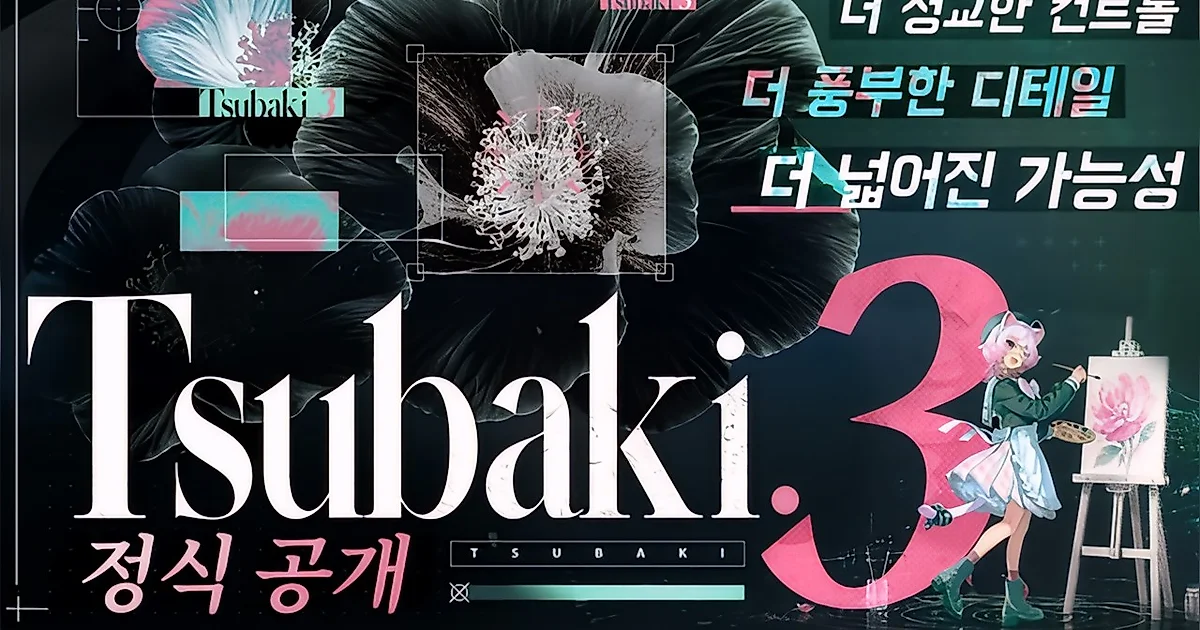
Metanomaly K.K., the operator of the global AI 2D creation platform PixAI, announced that it has officially launched its next-generation animation image generation model, 'Tsubaki.3'.
This model is characterized by a comprehensive enhancement of the 'creation process after the first image,' which involves not only the performance of generating a single image but also reusing and modifying already created characters to develop them into new settings, scenes, and comics.
Released to all users following approximately one month of early access, Tsubaki.3 applies smart reference using up to three images, natural language-based image editing, and color palette functions. It has also advanced basic generation capabilities required for content production, such as multi-character and complex scene expression, comic page production, prompt understanding, and text layout.
The model's native generation resolution has been expanded to a maximum of 2048×2048, approximately 4MP. Compared to the 1024×1024 of the previous generation Tsubaki.2, the horizontal and vertical resolutions are each doubled, and the total number of pixels is approximately four times higher.
Through Tsubaki.3, PixAI's strategy is to expand the competitive area of AI image generation from 'how well the first image is made' to 'how consistently the already created characters and ideas can be developed.'
Up to 4MP native generation... Overall enhancement of basic model performance compared to Tsubaki.2
Tsubaki.3 supports native image generation of up to 2048×2048. By expanding the high-resolution generation base, it allows for the expression of detailed elements such as characters, clothing, materials, and backgrounds with higher density.
The model's basic generation performance has also been generally improved, including prompt reflection, complex compositions, multi-character expression, lighting control, detailed depiction, and the range of style expression.
In conjunction with the official launch, PixAI released its own comparative test applying the same prompts to Tsubaki.2 and Tsubaki.3. The test focused on maintaining character features, text rendering, complex compositions and multi-person configurations, reflecting lighting instructions, and detailed expressions such as hair and lace.
In complex scenes, compositions where multiple people and visual elements appear simultaneously were tested, and in lighting tests, various conditions such as light direction and intensity, water surface reflection, projection, ambient lighting, and material reflection were compared using the same prompts.
The range of expressible styles has also been expanded. Different visual styles such as flat coloring, thick coloring, watercolor, line art, and pixel art can be utilized within a single model, and the scope of use has been widened to include scenes with various camera angles and perspective, full-body characters, multi-person configurations, and concept designs.
The first image is not the end... Character creation continues from reference images
The biggest change in Tsubaki.3 is the production process after generating a character.
In character-centered creation, even after obtaining a preferred first image, there are often cases where one must create various forms of results by changing the expression, clothing, pose, background, and viewpoint of the same character.
Tsubaki.3 has strengthened its Reference-based generation function, which produces the next result based on the character, composition, style, and key visual elements contained in the reference image.
In smart reference, up to 3 images can be utilized. Starting from a single character image, it can be expanded into various results needed for character settings, such as expression sheets, various clothing designs, poses, three-view drawings, and changes by age group.
Another feature is that character expansion can begin from a single reference image without having to configure and train a separate dataset. Rather than completely replacing the existing training-based character production method, it provides an option to quickly move to the next production stage from already secured character images.
PixAI does not define this as a function where the character remains completely identical in all situations. It focuses on relatively stably reusing the main appearance and atmosphere of the character based on the reference image and expanding it into new settings and scenes.
Instead of re-generating, modify the desired parts... From 'generation' to 'editing'
Tsubaki.3 has also strengthened the production workflow to modify and develop necessary parts based on already secured results, instead of repeatedly generating the entire image from scratch due to undesirable elements.
After uploading an image, users can edit the image by explaining in natural language where to modify, what to change, and which elements to maintain.
For example, it is a method of changing a character's hair color or clothing while maintaining other elements such as appearance, pose, background, and lighting as much as possible. It can also be used for correcting hand movements, adding or deleting objects, and changing text within an image.
By using image-to-image (img2img), it is also possible to redraw using a sketch or an existing image as a visual basis. It can be used in various production stages such as line art coloring and retouching, style transformation, and reconstructing realistic images into 2D animation styles.
The new color palette function supports specifying colors and ratios before generating the result or extracting color compositions from existing images to apply to new works.
In addition to selecting pre-set palettes, users can also create and save their own palettes, allowing for more specific control over the overall color scheme and atmosphere of the character and the work.
Through this, PixAI intends to expand AI image generation from a 'process of re-generating until the desired result is obtained' to a production process of modifying and selecting existing results and developing them to the next stage.
From a single character to a comic page... Panel composition, dialogue, and direction into a single result
Manga production is a representative area where Tsubaki.3 expands its scope of application from single image generation to content production.
Tsubaki.3 can compose manga pages containing multiple panels all at once, and can express traditional manga elements within a single image, such as panel division, speech bubbles, dialogue, screen tones, speed lines, close-ups and wide shots, various camera angles, and 4-panel manga.
When a user describes the story and scenes they want to show on a page using text prompts, it constructs manga-style results based on them. It is also possible to use a self-made character image as a reference image to produce panels and scenes where that character appears.
Through this, users can develop settings from a single character image, compose scenes involving relationships with other characters and events, and lead into manga pages and story expressions.
Rather than the automatic production of long-form webtoons, PixAI focused on production support that can be utilized in the actual story development process, such as character settings, storyboards, panel composition, and manga page production.
From multiple characters and complex compositions to text and lighting... Expanding the ability to handle 'scenes'
To produce story-type content, one must be able to compose not only individual characters but also the relationships between characters and the entire space together.
Tsubaki.3 focuses on reducing the phenomenon where character features mix in scenes where multiple people appear, and more clearly expressing the appearance, position, pose, gaze, and interaction for each person.
It also allows for more detailed composition of scenes that include physical relationships between people, such as characters contacting each other or holding and using objects.
The control range for lighting and camera direction has also been expanded. Users can specify the direction and intensity of light, color temperature, depth of field, focal length, composition, backlight, and hard light in prompts, and it can also be used for various optical and texture expressions such as underwater lighting, silhouettes, film grain, and lens flare.
Multilingual text rendering is also supported. Text in English, Japanese, Korean, Traditional Chinese, etc., can be expressed within the image, and it can be used to create layouts considering the position, hierarchy, direction, and surface form of the characters.
The scope of production has expanded to include content where text is included as part of the design, such as characters on clothes or curved surfaces, posters and title visuals, magazine-style layouts, and manga speech bubbles.
Not just finished images, but also the 'intermediate process'... Expanding from a generative model to a production workflow
Tsubaki.3 is not only for generating final images but can also be used to create various intermediate results required in the process of developing characters and content.
It can produce results for each production stage, including line art, grayscale, flat color, and finished images, as well as results needed for the character development process, such as pose and character setting images, three-view drawings, lighting changes, and designs from various perspectives.
It is designed to reduce the process of switching to a separate generative model for each task by connecting different tasks—such as text-based image generation, reference image-based generation, and natural language image editing—around a single model.
It also supports the custom styles and Style Code provided in the existing Tsubaki.2.
Along with the official launch, a new 'Creative Template' feature is also introduced, where creators can share their styles and production methods, and other users can utilize them immediately.
Through this, PixAI plans to expand the role of Tsubaki.3 beyond generating single results into a production workflow that creates, modifies, and develops characters.
From image to video... 'Tsubaki Video' series released simultaneously
While Tsubaki.3 is the central model for image and manga production, the simultaneously released 'Tsubaki Video' and 'Tsubaki Video Flash' play the role of expanding the same characters and scenes into moving content.
The Tsubaki Video series supports video generation that considers camera movement and viewpoint, the depth of space and scene structure, and the movement between people, objects, and backgrounds.
In character-centered videos, the focus is on implementing natural movements based on the key features of appearance and facial expressions.
PixAI's strategy is to expand the Tsubaki product line in a direction that continuously develops a single character and idea into various content formats such as images, manga, and video, rather than providing image generation and video production as separate experiences.
Tsubaki Video and Tsubaki Video Flash can be used by all users regardless of membership subscription, and to celebrate the launch, the generation cost is discounted by 30% until October 20.
'From a better single shot' to 'Creation after the first page'
The change aimed for by Tsubaki.3 does not stop at simply generating higher resolution or more sophisticated images.
The core is a production flow that reuses characters already made from reference images, modifies desired parts, expands them into new outfits, expressions, settings, and scenes, and then develops them into other content such as manga and video.
PixAI defines this as a character-centered creation structure that leads from 'Reference → Edit → Develop'.
Instead of searching for a new result from scratch every time after obtaining the first image, it is a method of continuing creation by using the already made characters and images as materials for the next production stage.
PixAI stated that the biggest change in Tsubaki.3 lies in the creation process after the moment the first image is made, and that the production scope of the model has been expanded so that users can reuse characters from a single reference image, modify necessary parts, and lead into settings, scenes, and manga.
Furthermore, it added that while high resolution and image quality are basic, how long a user can utilize their own characters and ideas and develop them into various contents will be an important future competitiveness, and they will continue to expand the character-centered content production environment by connecting to the Tsubaki Video series.
Global creation contest held to celebrate the official launch
To celebrate the official launch of Tsubaki.3, PixAI is also holding a global creative contest until October 20.
Participants can enter with works utilizing Tsubaki.3 without restrictions on style or theme, and can apply through the PixAI platform and official X. Winners will be provided with PixAI credits, Amazon gift cards, and more.
Through this contest, PixAI plans to share with the global community how Tsubaki.3's features—such as character expansion based on reference images, image editing, comic page production, and the composition of multiple characters and complex scenes—are utilized in actual creators' works.
PixAI is a global AI creative platform that supports 2D creation, such as animation and illustration, based on generative AI technology.
Since starting service in October 2022, it has secured more than 16 million registered users worldwide and is expanding its global user base, centered around regions with active creative cultures such as Korea, North America, and Taiwan.
PixAI provides the proprietary Tsubaki model series specialized for animation and 2D image generation, as well as 'Mio.2', an AI creative agent that can produce images and comics based on natural language conversation, 'PixAI Edit Pro(v1.0)', a natural language-based image editing model, and 'PixAI Studio', a node-based integrated AI creative workspace that connects image, video, text, and audio with generation and editing stages.
With the slogan 'Imagination, made real', PixAI aims to build an AI creative environment where anyone can visualize their ideas and develop them into characters, stories, and various types of content.
· PixAI Tsubaki.3
· Tsubaki.3 Detailed Introduction and Tutorial
· PixAI Official Website
· PixAI Official Blog
· PixAI Official X
· PixAI Official Discord
· PixAI iOS
· PixAI Android
About Metanomaly K.K.
Metanomaly K.K. is a generative AI technology company headquartered in Tokyo, Japan, which develops and operates the global creative platform 'PixAI'. Since its launch in October 2022, PixAI has been used by more than 16 million people worldwide, providing AI image generation services for illustration, character design, and content production. PixAI ranked 1st in graphics category sales and 6th in the AI category on the Japanese App Store in the first half of 2025. Under the vision of 'Imagination, made real', Metanomaly K.K. is expanding an environment where anyone can easily begin creative activities.
◆ At a Glance
· Issuing Organization : Metanomaly K.K.
· Classification : Artificial Intelligence, Animation, Metanomaly K.K.
· Distribution : September 17, 2026, at 9:40 AM
Source : Metanomaly K.K. Press Release (Newswire)
Special Times is striving to deliver faster and more diverse news to readers with the help of AI technology.
Comments 0