
The story of the day when the tail was bitten, illuminating the tragedy of Gwangju Grand Complex... Ranks 1st in 2049 viewership
The SBS program 'The story of the day when the tail was bitten' highlighted the 1971 Gwangju Grand Complex incident, a major urban poverty struggle in Korea…
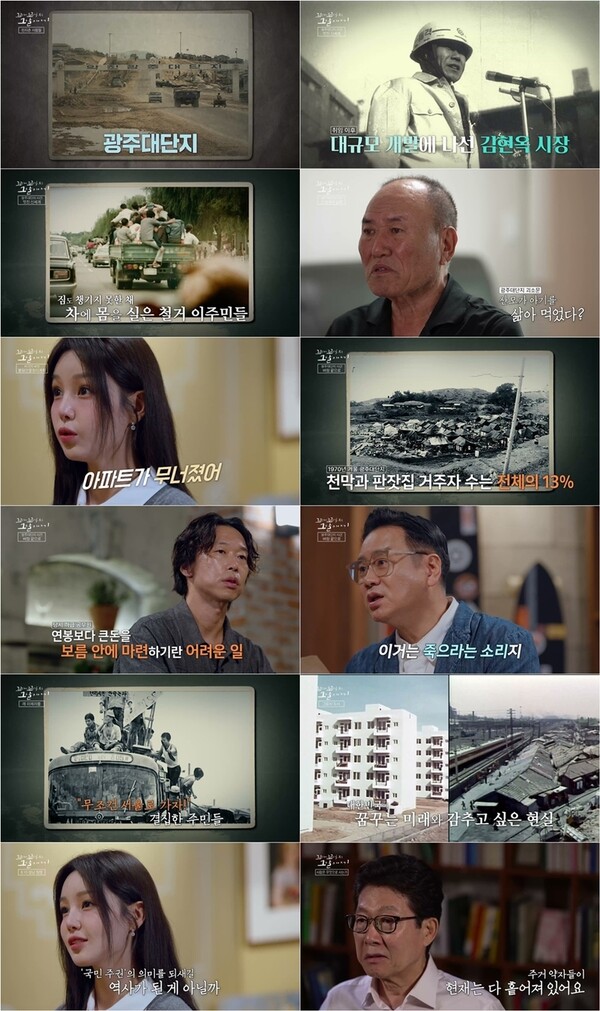
SBS 'The story of the day when the tail was bitten' aired the episode on the 27th. Singer and actress Nam Gyu-ri, along with actors Lee Kwang-ki and Yoon Byung-hee, appeared as listeners to examine the reality of the '8.10 Seongnam Uprising,' which is evaluated as South Korea's first large-scale urban poverty struggle. The 2049 viewership rating for this broadcast was 0.9%, ranking 1st among educational and entertainment programs in the same time slot.
The broadcast covered the civil unrest on August 10, 1971, in the Gwangju area of Gyeonggi-do, where tens of thousands of residents occupied government offices and burned vehicles. When shantytowns were exposed to foreign media during President Johnson's visit to South Korea in 1966, President Park Chung-hee ordered the demolition to the then-Seoul Mayor Kim Hyeon-ok, and the Seoul Metropolitan Government relocated residents to the Gwangju Grand Complex, promising to build new city infrastructure. However, only tents were placed in a field lacking electricity, water, and roads, with four households living in a single tent. Due to a lack of wells, residents who drank contaminated water suffered from mass colitis, and Mayor Kim Hyeon-ok is said to have left the remark, “Once you gather about 100,000 people, they will naturally find a way to prey on each other to survive.”
The broadcast also introduced the background of how urban legends such as “a mother boiled and ate her baby” spread as children died of freezing in extreme cold waves and deaths from malnutrition surged. In reality, it was a tragedy where mothers who gave birth amidst extreme famine and their newborn babies died together due to malnutrition. Ultimately, when the promise of a dialogue with the Seoul Mayor on August 10 was not kept, residents burned official and police vehicles and attempted to head toward the Blue House after hijacking buses, but the government suppressed them by deploying police riot squads.
The listeners expressed misery throughout the broadcast. Yoon Byung-hee said, “Just listening to it is painful and devastating,” and Lee Kwang-ki said, “It is not a place of living, but a city of death.” Nam Gyu-ri stated, “It is truly unfair,” revealing, “I have also lived in a rooftop room once,” and asked, “Isn't the issue of the housing vulnerable still an unsolved homework?” Lee Kwang-ki defined this incident as “the actions of people who wanted to tell their stories for survival.”
Program Information
'The story of the day when the tail was bitten' is a program where three storytellers study on their own and convey what they felt to their respective 'story friends' 1:1 in everyday spaces, and it airs every Thursday at 10:20 PM on SBS.
| Item | Content |
|---|---|
| Program | The story of the day when the tail was bitten |
| Broadcast | SBS, every Thursday at 10:20 PM |
| Topic | 1971 Gwangju Grand Complex Incident (8.10 Seongnam Uprising) |
| Cast | Nam Gyu-ri, Lee Kwang-ki, Yoon Byung-hee |
Source: SBS Press Release
Special Times is striving to deliver faster and more diverse news to readers with the help of AI technology.


Comments 0