
Hired by Hyundai Motor Company in Their Final Year of High School: Vocational Graduates Share Career Paths on SBS
The first episode of SBS's "Rewriting the Formula for Success: Young Workers Are on Their Way to Work" featured vocational high school graduates working at Hyundai Motor Company, Samsung Electronics, Toss and SK hynix, as well as one who runs an orchard. Several continued their studies at university after starting work.
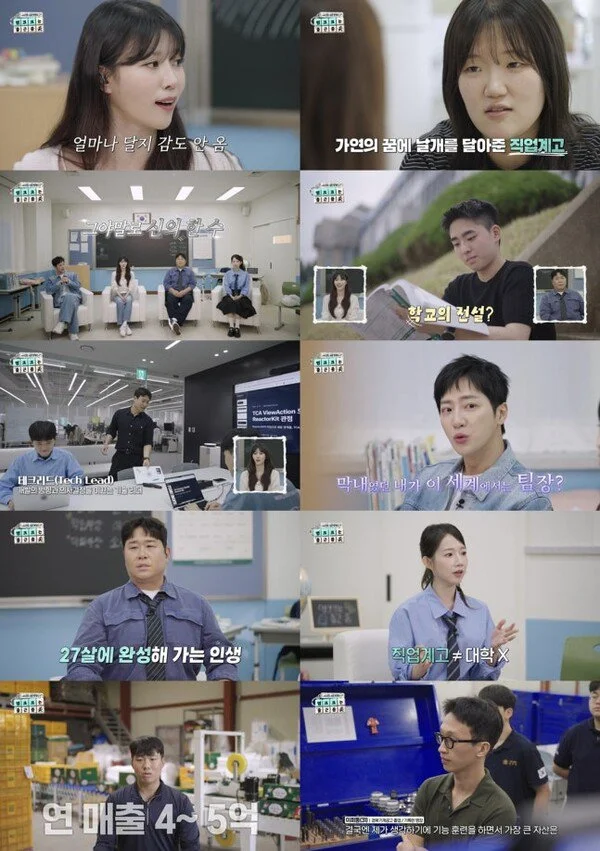
A young person who passed Hyundai Motor Company's hiring in the third year of high school, after earning 20 certificates, appeared on the first episode of SBS's educational program "Rewriting the Formula for Success: Young Workers Are on Their Way to Work," aired on the 18th. The episode profiled vocational high school graduates who joined large corporations and IT companies, or kept studying while working.
Offers before graduation, degrees after starting work
The Hyundai Motor Company hire said they had loved handling machines since childhood and chose a Meister high school over an academic one. They stayed top of the school for all three years, earned 20 certificates and received the Korea Talent Award. A preview said the company waited for the hire to finish military service before starting. Broadcaster Lee Mi-joo reacted to the résumé by asking, "Is it only legends today?" The hire also said they plan to study mechanical and electronic fields in greater depth, and So Seul-ji used the segment to explain that vocational high school graduates can still go to university under the "employ first, study later" system.
A Samsung Electronics engineer who is a WorldSkills Competition gold medalist used that same system to earn a degree in English language and literature, and is now studying Chinese. The broadcast said the engineer's language skills are good enough to lead production-line tours when overseas buyers or VIPs visit. For more than 10 years after graduating, the engineer has returned to the alma mater once or twice a month to mentor younger students, and one of them called the engineer "like Son Heung-min in football." The broadcast presented this as a case of keeping close ties with the school and its students while working at Samsung Electronics on the strength of shop-floor skills. Moon Se-yoon remarked, "We're really learning a lot today too."
Another guest, a 25-year-old who graduated from a specialized vocational high school and went on to run an apple farm, enrolled at university last year to solve problems met while farming. The guest now studies plant medicine and, with their parents, runs an orchard of more than 10,000 pyeong with annual sales of 400 million to 500 million won, the broadcast said. Lee Mi-joo said after watching: "Today's video makes me look back at myself." The episode's cases also covered corporate jobs, development work, agriculture, university study, certifications and training of juniors, all different routes. Guests started work first on the strength of skills learned at vocational schools, then built field experience or went back to university as needed.
| Case featured in the broadcast | Age | Amount/scale |
|---|---|---|
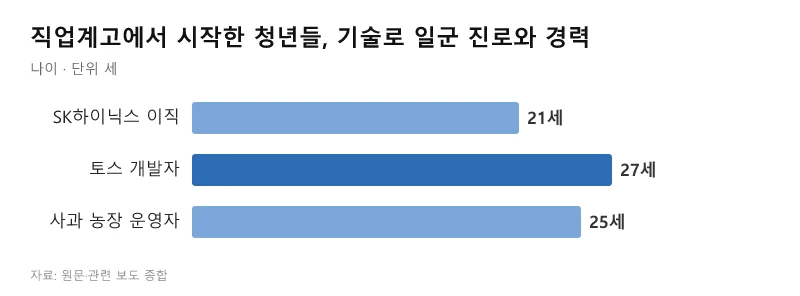
| SK hynix job-changer | 21 | 70 million–80 million won |
| Toss developer | 27 | |
| Apple farm operator | 25 | 400 million–500 million won |
From the developer's desk to the chip lines
A 27-year-old Meister high school graduate who works as a developer at Toss said they admired hackers after watching the SBS drama "Phantom" and enrolled at the school for that reason. Skills and project experience gained there helped in landing the developer job. The broadcast said the developer works alongside developers from elite universities and leads the development team; a preview had described the role as tech lead. A colleague from a Seoul university said that on seeing the developer easily solve a difficult piece of code the colleague had been struggling with, "I felt Meister high school is an amazing place."
The developer is married and plans to buy a home in Seoul, which the program presented as a picture of a vocational graduate's life today. Moon Se-yoon said it "feels like being 15 to 20 years ahead of people your age." The program framed the story as a career built on development skill and experience rather than academic credentials, with the developer working in the field first instead of going to university.
Another Meister high school graduate moved from KAI to SK hynix at 21. After seeing graduates struggle to find jobs as a middle schooler, this person decided to acquire a skill of their own and chose a Meister school over university. A preview said that in high school the graduate began each day at 3:30 a.m., studied through lunch and stayed first in the school. The graduate said the first job at KAI paid a salary of 70 million to 80 million won, and that skills and experience from high school laid the groundwork for the move to SK hynix. Actor Lee Sang-yeob said of the choice of school, "Choosing that school was a masterstroke."
Behind the shift away from diplomas
The program also touched on hiring trends that have moved away from treating a university degree as essential. It cited the fact that 3 to 4 out of 10 graduates of good universities still fail to find jobs, and SK hynix's decision to scrap academic requirements. One job-market expert called the trend "the end of the credential, accelerated by AI." Alongside the growth of the artificial intelligence industry, the broadcast covered record earnings and bonuses at chip companies. When an SK hynix production worker said, "I work in production at SK hynix, and life is sweet," Lee Mi-joo replied: "I don't envy others, but with a bonus in the hundreds of millions of won, life would really be sweet."
Broadcast schedule
"Rewriting the Formula for Success: Young Workers Are on Their Way to Work" is a two-part program on SBS. The second part is scheduled to air on the 25th at 10:55 a.m.

Covers K-pop for SPECIALTIMES GLOBAL, and also writes Culture and K-Variety stories.


Comments 0
Comments are currently disabled.