
Naibi launches MUSIEUM to turn album art into limited canvas collections
Music IP tech startup Naibi has announced the launch of MUSIEUM, an art edition brand that produces and sells limited-edition canvas collections of music album artwork.
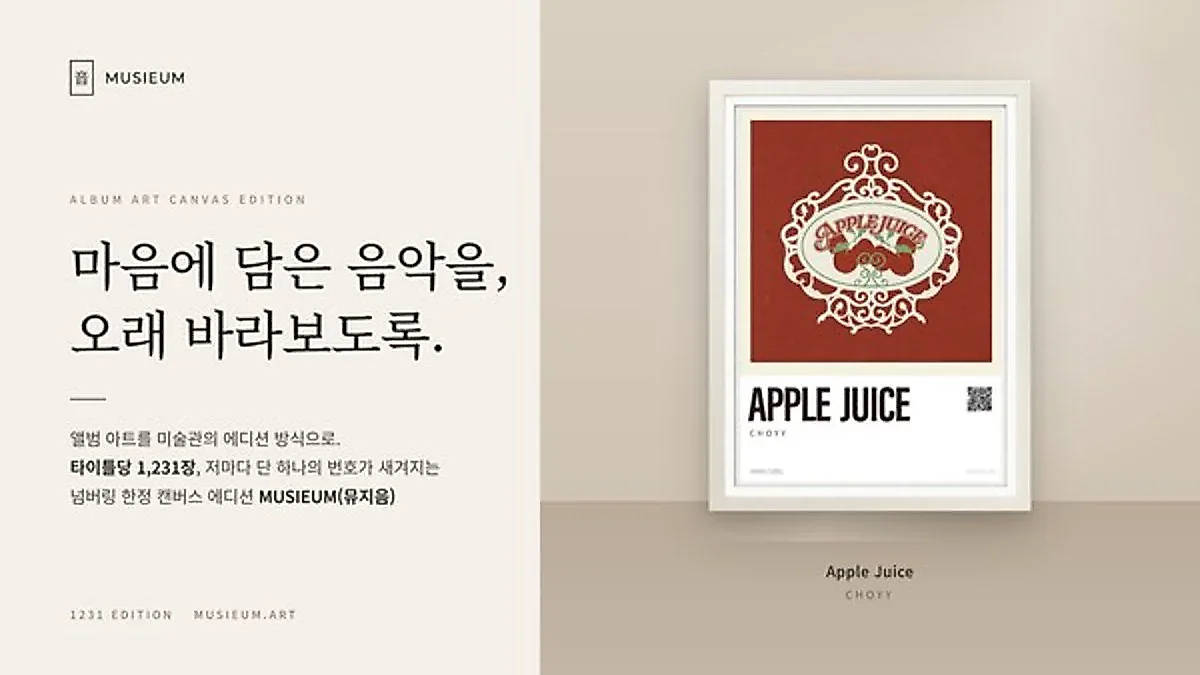
Music IP startup Naibi has launched MUSIEUM, a brand that produces limited-edition canvas collections of album artwork. The "1231 Edition" line will release at most 1,231 numbered copies per title, starting with the music catalog from Colortones.
Music IP tech startup Naibi (CEO Kim Dong-hyeon) has announced the launch of MUSIEUM, an art edition brand that produces and sells music albums as limited-edition canvas collections.
MUSIEUM positions itself as a "gallery where music resides." The brand's starting point is to return album artwork to a collectible form by adopting the print edition methods used in art museums. All products are manufactured in gallery edition specifications, consisting of a full-print artwork on canvas with a white band at the bottom.
Background for launch - Album art, another face of music
Album art serves as the face of music, symbolizing the completed sound. Once a song is finished, musicians and graphic artists undergo numerous drafts and discussions to condense the emotions and worldview contained within into a single image. Every element—the temperature of a color, the thickness of a typeface, and even the light and negative space in a photograph—is carefully selected to follow the story the music intends to convey. Consequently, a single piece of album art contains layers of the musician's intention, the graphic artist's interpretation, and the single answer they found together. The completed cover becomes the first impression when a listener encounters the music and serves as a marker of memory that brings the music back to mind after time has passed. This process of translating sound into a visual language is considered one of the most delicate and intensive creative stages in record production.
In the streaming environment, these results usually pass by as small thumbnails. As album art stays for only a few seconds while fingers scroll through playlists, the opportunity to look closely at the details and stories within is diminishing. As the experience of holding and flipping through LP and CD covers disappears, the lingering resonance created by the union of music and image also fades. MUSIEUM began at this exact point: to take the artwork, which condenses the identity of the music, and present it again as a piece of art by adding appropriate size, material, and scarcity.
The direction MUSIEUM aims for is the "upscaling" of music IP. Even for the same artwork, its value is conveyed differently depending on the format in which it is contained. MUSIEUM redesigns the creative asset of album art into a collectible by utilizing numbered editions limited to 1,231 copies per title, gallery-level specifications and materials, and ownership authentication based on Objem.
Through this, the brand intends to provide fans with the experience of keeping their favorite music close and gazing at it for a long time, while offering artists and rights holders the opportunity to newly expand the value of music IP beyond digital streaming.
1,231 copies per title - '1231 Edition'
The basic line of MUSIEUM, the "1231 Edition," is a numbered limited edition produced in quantities of at most 1,231 copies per title.
Each canvas is assigned a unique number from 0001 to 1231, and duplicate numbers are never issued.
Viewing and ownership authentication via a single QR code
Scanning the QR code at the bottom of the product connects to the streaming page of the corresponding album, making the artwork hanging on the wall a direct point of playback. This is combined with Objem, an ownership authentication solution developed by Naibi. Buyers can verify authenticity and register ownership using a unique authentication code included with the product, technically ensuring the scarcity of the limited edition.
Trademark and design rights filed - IP-based brand design
Naibi has completed the filing of trademarks for MUSIEUM and three product design rights. As a business dealing with the IP of album art, the company explained that it first designed the brand and product specifications as intellectual property.
Partnership program for agencies and IP rights holders
Starting with the music IP catalog of the music label Colortones, MUSIEUM will expand its lineup to include artwork from new albums of external agencies and IP rights holders. Partner agencies can participate simply by providing the artwork license, while MUSIEUM takes full responsibility for production, sales, delivery, and customer service, with a structure that allows for the distribution of sales profits. As the production and delivery method involves collaboration with companies specializing in art printing and delivery, such as lithographs, there is no initial investment or inventory burden for agencies. The goal is to operate new releases as limited drops linked to album launches and older releases as masterpiece editions, converting artwork in the catalog into new revenue assets.
Expansion into offline events such as showcases and fan signings
Naibi possesses touchpoints with various entertainment companies through years of entertainment marketing business. Based on this, the company plans to expand its business by collaborating with K-POP agencies to fuse edition releases with offline events such as showcases, fan signings, and pop-up exhibitions. The plan is to provide album release campaigns and fan events as a single package, where the limited edition canvases serve as both exhibition pieces at event sites and official merchandise.
“In the streaming era, music has shifted from ownership to playback, but the desire to keep a favorite album close has not disappeared,” said Naibi CEO Kim Dong-hyeon. “Album art is another work completed after musicians and graphic artists spend a long time contemplating the identity of the music. MUSIEUM aims to be a brand that moves that work from a small screen in the palm of your hand to a scene on a wall, elevating the value of music IP by one step.” He added, “As we have designed it so that agencies can start without burden even with single title releases, we will ensure more music remains as a work that can be gazed upon for a long time.”
MUSIEUM: https://musieum.art

Covers K-pop for SPECIALTIMES GLOBAL, and also writes Culture and K-Variety stories.



Comments 0
Comments are currently disabled.