
The 4-Day Workweek that Lowered Severance Hospital Nurses' Resignation Rate by 12.5%p, Questioning the Future of Labor in Korea
MBC's PD Note explores the feasibility and impact of the four-day workweek…
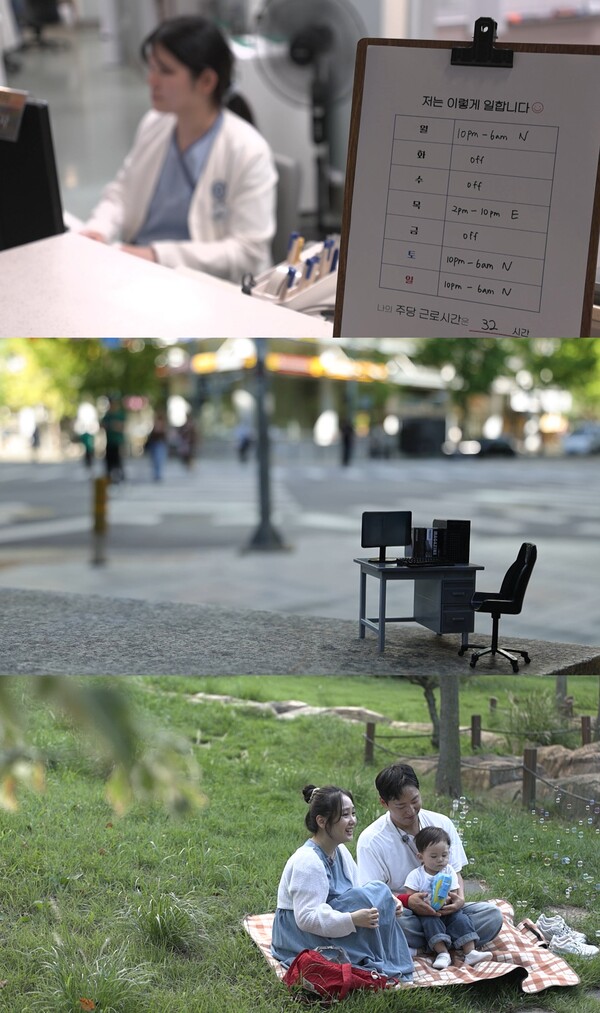
* Broadcast: September 15 (Tue) at 10:30 PM
It has been over twenty years since the five-day workweek was introduced amid concerns that it would "lose one's livelihood while trying to improve the quality of life." However, we still work "too much." In 2025, Korea's annual working hours are 1,833, ranking 6th among 38 OECD countries. Only Mexico, Costa Rica, Chile, Greece, and Israel work longer than us.
Experiments to escape long working hours are continuing all over the world. At the center of this is the "four-day workweek." It is an attempt to change the way we work so that more results can be achieved in less time. If the day we left at the workplace were returned to us, what could we do? And what is needed so that everyone can enjoy that day?
MBC 〈PD Note〉 looks into our society standing before the massive question of the "four-day workweek."
- People for whom 24 hours are not enough
Last year, 1,376 workers died due to occupational diseases. Among them, 408 deaths were from cerebrovascular and cardiovascular diseases related to overwork. Professor Juan Sánchez of the University of Valencia in Spain, who has studied the reduction of working hours, said he was surprised to hear the term "gwaro-sa" (death by overwork) in Korea. "We don't have such a word."
In the Korean society that works this long, most of us are in a state of "time poverty." This is a state where there is a lack of "discretionary time" that can be used entirely for oneself after subtracting labor and sleep from the 24 hours of the day. The mornings of dual-income Bubu are split into minute increments, and office workers find it difficult to even find time to care for themselves as they only move between home and the workplace. People who fall into "isolation" both when they go to work and when they return home. For us who work this long, is it truly possible to reduce a day?
- People who have already reduced a day
People often think of the four-day workweek as a "dream-like story" or "something only possible for large corporations or civil servants." However, there are places that have made this a reality. An IT company in Daegu created its own solution to share tasks and schedules in order to reduce "pseudo work"—time-consuming tasks unrelated to the essence of work, such as unnecessary meetings and formal approvals or reports. They used the time saved that way to create a day off. An automatic door manufacturing company in Gyeonggi-do and a food manufacturing company in Sejong City created holidays by increasing productivity through smart factories and automated equipment.
Across the ocean, much larger-scale experiments were conducted. In 2022, the world's largest four-day workweek experiment was held in the UK, involving approximately 2,900 workers from 61 companies. Workers' stress decreased, and corporate revenue did not fluctuate significantly. Even after the experiment ended, 90% of the participating companies continued the four-day workweek. In 2023, the entire city of Valencia, Spain, entered a four-day workweek for one month. As a result, citizens' health and urban air pollution improved. The concern that the city would stop was merely groundless worry. What was confirmed in the overseas cases investigated by 〈PD Note〉 was clear: even if working hours were reduced, performance did not collapse, and people's lives improved.
- Now, it is time to contemplate
A hospital that cannot stop for 24 hours. For nurses suffering from extreme work intensity, the four-day workweek seemed like an even more distant story. However, Severance Hospital introduced a four-day workweek pilot program in 2023. The result was surprising. The resignation rate of nurses with less than three years of experience plummeted from 19.5% to 7%, and the number of sick days also decreased. As exhausted nurses recovered, not only job satisfaction but also the quality of patient care increased. However, this day was not easily obtained. It required adjusting the working methods and structures themselves, such as three years of labor-management negotiations and the additional labor cost burden from securing replacement personnel.
As such, reducing working hours is not easy. Furthermore, 99% of Korean companies are small and medium-sized enterprises (SMEs), and 88% of workers are employed in SMEs. If the four-day workweek is only introduced in places with the necessary conditions, such as large corporations and public institutions that have the capacity to hire additional personnel and improve working methods, it could lead to another polarization of labor.
The four-day workweek is not simply a matter of how much to reduce working hours. How is a society possible where anyone can enjoy that day? Furthermore, what kind of lives will we lead when we reclaim the day we gave to the workplace? A question that asks for the standards of life beyond the way we work, MBC 〈PD Note〉 "Four-Day Workweek, We Return Your Day" will be broadcast on the 15th at 10:30 PM.
◆ At a Glance
· Publishing Institution: MBC
· Category: PD Note
· Distribution: September 14, 14:00
Source: MBC Press Release
Special Times is striving to deliver faster and more diverse news to readers with the help of AI technology.
![[2026 Asian Games] SBS commentator Tony Akins shares victory strategy for Korea-Japan match and advice for Lee Jung Hyun](/storage/specialtimes-global/2026/09/29941b39-b4c1-4972-ba7f-1dbae1385b58-217f606e-thumb.webp)


Comments 0